
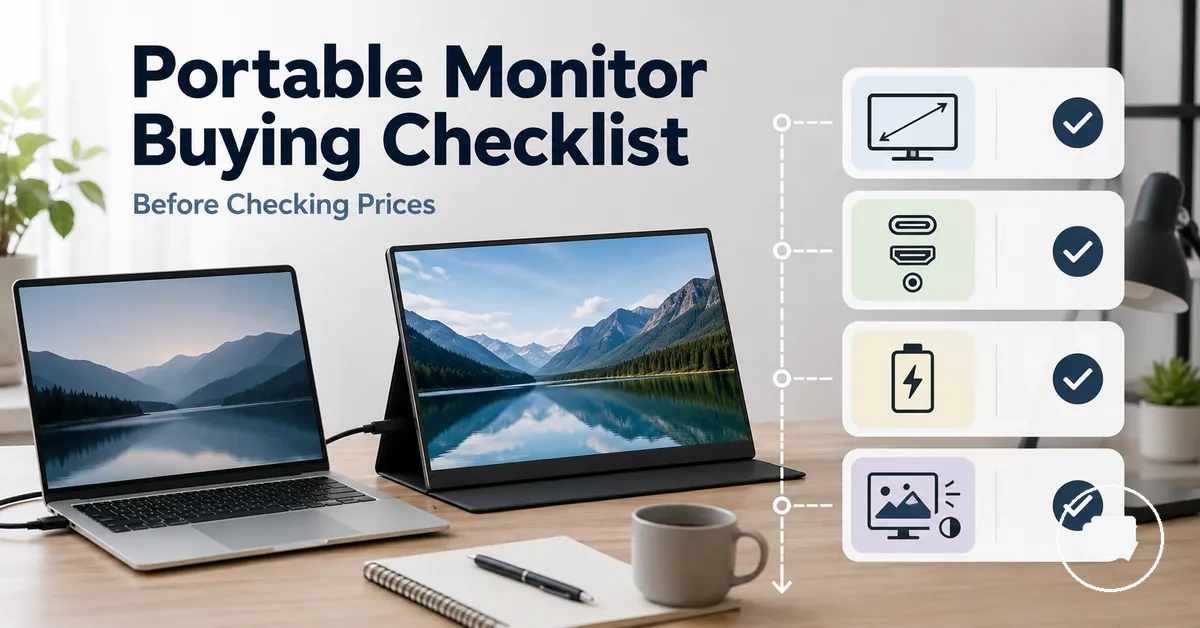
Portable monitor buying checklist for price-ready selection
A portable monitor buying checklist is a pre-price decision filter that helps determine whether a portable monitor matches the intended use case before comparing prices. It keeps price-ready selection focused on compatibility, display requirements, accessories, value, and potential buying mistakes instead of product rankings or catalogue-style comparisons.
A portable monitor that appears suitable at first glance may not fit every setup. Device connections, available power, workspace, travel needs, and intended tasks can all influence whether a portable display is an appropriate choice, so checking these conditions before comparing offers can reduce the risk of an unsuitable purchase.
The primary decision is to separate must-pass requirements from personal preferences. Compatibility, connection options, power needs, and practical usability should be confirmed first, while display comfort, screen finish, accessories, and perceived value can then be evaluated according to individual priorities.
The checklist below organizes the key checks for requirement, compatibility, display, accessories, and value before price comparison. It is intended as a purchase-readiness filter rather than a product recommendation.
- Use case: Confirm that the portable monitor suits the intended device, workspace, travel routine, and everyday tasks.
- Display requirements: Review resolution, brightness, screen finish, and screen size based on the expected viewing environment.
- Compatibility: Check whether USB-C, HDMI, power requirements, cables, or adapters are appropriate for the target device.
- Accessories: Verify whether a stand, protective case, cable kit, or required power accessories are included or already available.
- Buying mistakes: Avoid selecting a portable monitor based only on price, appearance, or assumed compatibility.
- Value: Compare offers only after the essential requirements have been confirmed, as missing accessories or limited compatibility may affect overall value.
Use-case fit before choosing a portable monitor
Use case should define the selection frame before price because the right portable monitor depends on the intended device, environment, and working context. A portable monitor that suits one situation may be less suitable in another, so matching the intended use before comparing specifications helps narrow the selection. This first decision filter reduces the chance of evaluating options that do not fit the expected conditions.
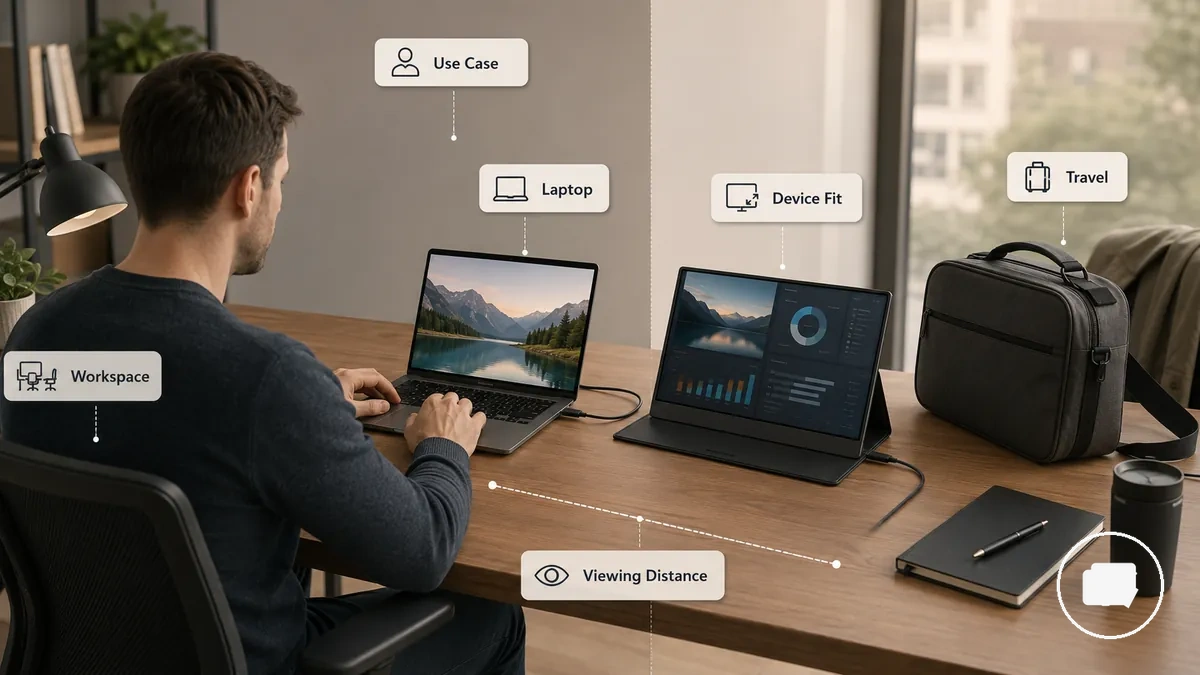
For regular laptop work at a desk, viewing distance and workspace arrangement may take priority over maximum portability. Frequent travel may shift the selection priority toward easier carrying, bag fit, and convenient power access, while occasional second-screen use may justify a different balance of features. For broader buying considerations beyond this first decision filter, see the portable monitor guide.
Use-case fit before choosing a portable monitor becomes easier to judge when the device, environment, and viewing distance are considered together. The image below illustrates how these conditions influence the initial selection, and the checklist verifies the key decision points before moving on to specifications or price.
- Confirm the primary device supports the intended connection method.
- Consider whether the portable monitor will be used mainly at a desk, while travelling, or in multiple locations.
- Check whether the expected viewing distance supports comfortable use in the intended workspace.
- Decide how important portability is for carrying the display between locations.
- Consider whether extra cables or adapters are acceptable or would become a rejection signal.
Primary device and working environment
Identify the primary device and working environment before evaluating a portable monitor. A laptop, phone, tablet, or console may require different conditions depending on where the display will be used. The work setting can change which available ports, surface space, and power access should be checked first.
The working environment changes the required checks because connection, space, and power needs may differ between locations. For example, a laptop in a desk setup may benefit from stable surface space and a comfortable viewing angle, while mobile use may place greater emphasis on available power access and carrying convenience.
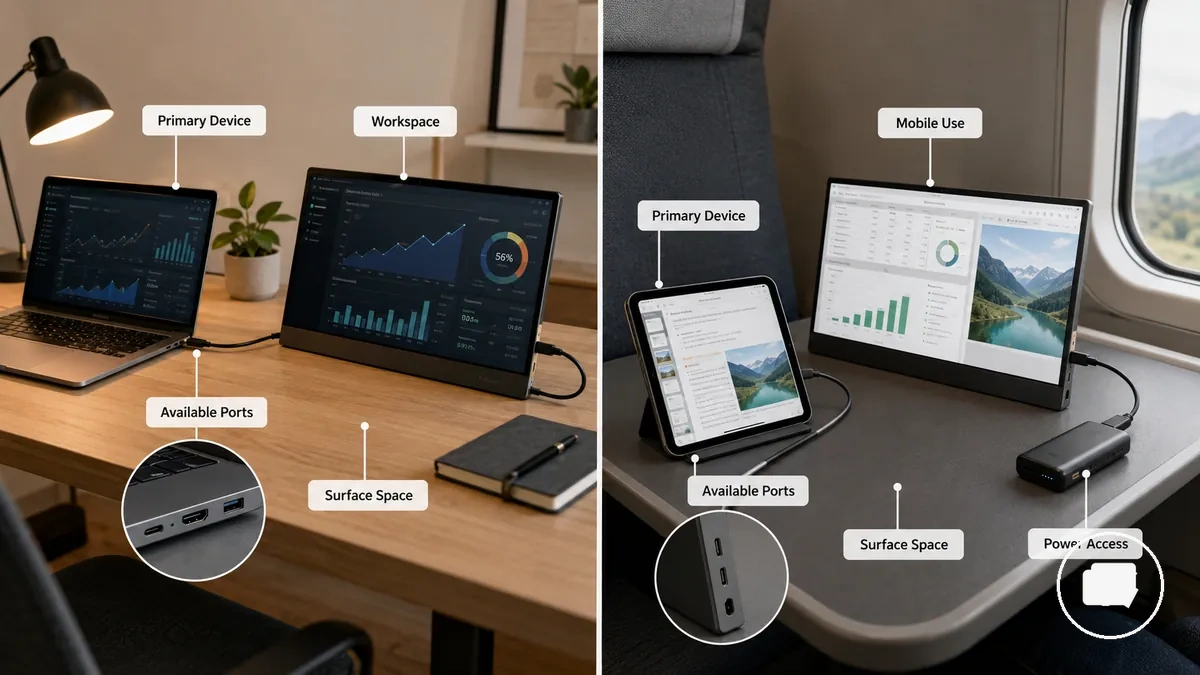
The primary device and working environment below highlight the local conditions that should be verified before moving to broader compatibility checks.
- Laptop: Check available ports and confirm the workspace provides enough surface space for comfortable use.
- Phone: Verify that the intended working environment can support the required connection method and power access.
- Tablet: Consider available ports, viewing angle, and the space available for the portable monitor.
- Console: Confirm that the planned location provides suitable power access and enough surface space for the display.
- Mobile use: If the portable monitor will travel frequently, consider whether carrying needs and power access remain practical.
Screen size, weight, and carrying limits
Screen size and weight should be evaluated together because portability depends on balancing readability with carrying limits. A larger screen may improve viewing comfort at the expected viewing distance, while additional weight, thickness, and case bulk can increase the travel burden. The most practical size range depends on the intended workspace and carrying context.
Bag fit, readability, and available desk space often influence whether a portable monitor remains comfortable to use and easy to carry. The image below compares screen size, weight, and carrying limits by showing how the display relates to a laptop, bag, and workspace before reviewing the portability trade-offs.
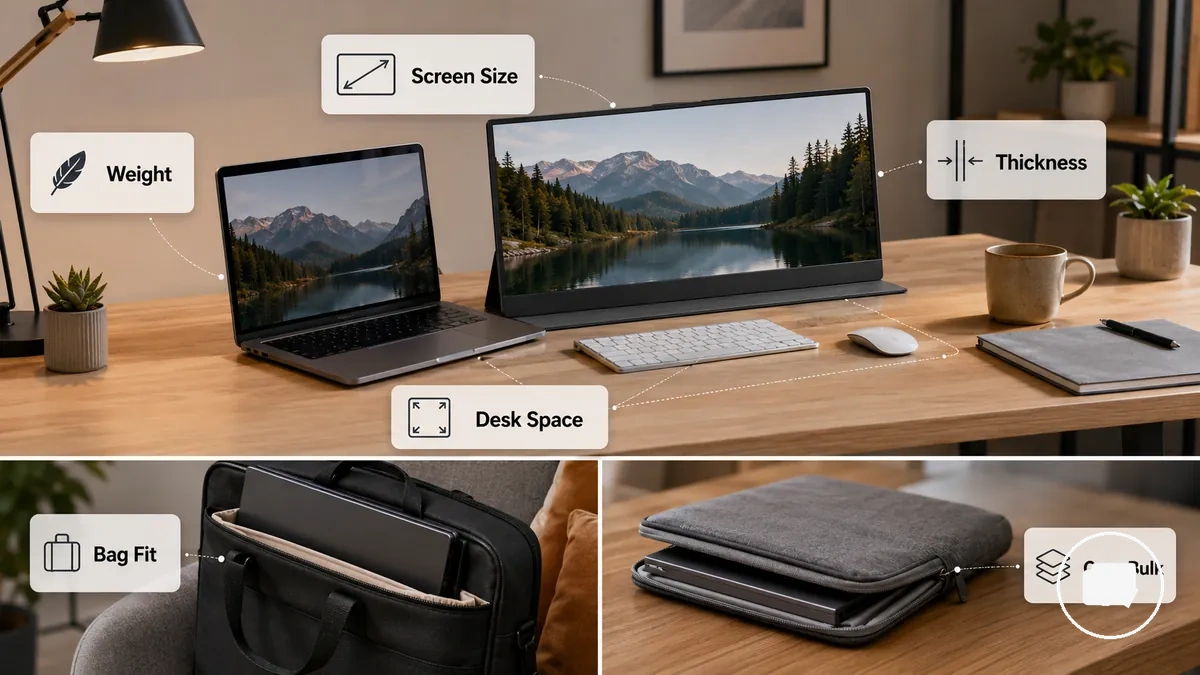
A compact workspace may favour a smaller footprint, while frequent travel may place greater emphasis on reducing carry weight and case bulk. A desk extension may allow a larger screen size when carrying limits are less restrictive.
| Factor | Condition to check | Decision effect |
|---|---|---|
| Screen size | Matches readability needs at the expected viewing distance | May improve comfort or require more desk space |
| Weight | Fits the intended carrying limits | May reduce or increase travel burden |
| Thickness | Fits comfortably with other carried items | Can affect portability and storage |
| Case bulk | Remains practical for everyday transport | May influence carrying convenience |
| Bag fit | Fits the intended bag or sleeve without excessive crowding | Can help determine whether the chosen size range is practical |
Display specifications that affect real use
Display specifications matter only when they are connected to real use rather than viewed as isolated feature labels. Resolution, aspect ratio, brightness, panel type, screen finish, and touch input work together to influence readability, glare control, and workflow fit. A higher specification may improve one use case while offering limited practical value for another.
Display quality depends on how screen attributes combine instead of relying on a single specification. Resolution can affect text clarity and scaling, while aspect ratio may influence how content fits the screen. Brightness and screen finish can change glare control depending on the viewing environment, and panel type may affect viewing angle and colour expectations. Touch input may add value when device support and workflow needs align, but it is not essential for every user.
The display specifications that affect real use below organize the main attributes by their practical effect. Use the table to compare selection criteria instead of focusing on individual feature labels, as the most suitable combination depends on the intended workflow and cost trade-off.
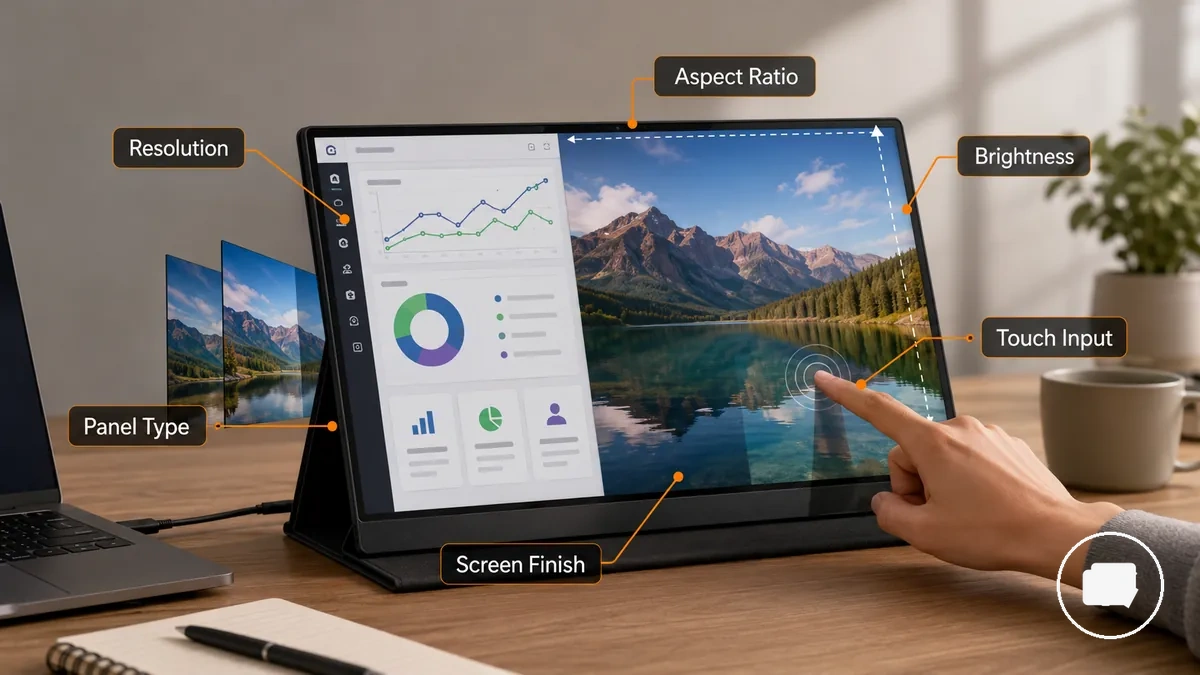
| Specification | What to check | Practical effect | When it matters |
|---|---|---|---|
| Resolution | Text clarity and scaling | May improve readability | Reading documents or detailed work |
| Aspect ratio | Screen layout | Can influence workflow fit | Multitasking or media viewing |
| Brightness | Viewing environment | May improve glare control | Bright or changing lighting conditions |
| Panel type | Viewing angle and colour expectations | Can influence display quality | Shared viewing or varied work positions |
| Screen finish | Reflection handling | May reduce visible glare | Rooms with direct light sources |
| Touch input | Device support and workflow need | Can provide additional interaction | When touch control supports the intended task |
Resolution, aspect ratio, and text clarity
Resolution and aspect ratio determine how clearly content is displayed and how efficiently screen space is used. Resolution works with pixel density and screen size to influence text clarity and perceived sharpness, while aspect ratio affects workspace shape and the way documents or applications are arranged. The comparison below organizes these attributes by their practical effect rather than treating either one as a standalone specification.
Scaling can influence reading comfort because higher resolution on a smaller screen size may require interface scaling to maintain comfortable text size. Aspect ratio can also change usable workspace by providing more horizontal or vertical room, depending on the intended workflow. For example, if a portable monitor is mainly used for document work or spreadsheet use, balancing resolution, pixel density, screen size, and workspace shape may provide a more comfortable experience than selecting the highest available resolution alone.
| Attribute checked | Decision effect |
|---|---|
| Resolution and pixel density | May improve text clarity and sharpness when matched with screen size and comfortable scaling. |
| Aspect ratio and workspace shape | Can influence usable workspace and reading comfort depending on the intended task. |
Brightness, panel type, and screen finish
Room light and screen surface determine how easily a portable monitor can be viewed in everyday environments. Brightness, panel type, and screen finish should be considered together because visibility depends on both the surrounding light level and the display surface. The table below compares these attributes by their effect on screen visibility rather than treating any single specification as a standalone indicator.
Brightness may improve screen visibility when matched to the surrounding light level, while the usefulness of higher nits depends on the environment. Panel type can influence viewing angle and colour expectations, and screen finish affects how matte or glossy surfaces respond to glare and reflections. In brighter rooms, a matte finish may reduce visible glare, whereas a glossy finish may be more suitable in controlled lighting, so readability and potential eye-strain risk depend on the viewing conditions.
| Attribute | Condition | Visibility effect |
|---|---|---|
| Brightness | Light level and available nits | May improve visibility when matched to the environment |
| Panel type | Viewing angle requirements | Can influence screen visibility from different positions |
| Matte screen finish | Bright rooms with greater glare exposure | May reduce visible reflections and support readability |
| Glossy screen finish | Controlled indoor lighting | May increase reflections when glare is present |
Touchscreen value versus standard display use
Touchscreen value depends on device support and workflow need rather than the display alone. Touch input should be considered only after confirming operating-system support and cable requirements, because compatibility can vary between devices. If touch support is uncertain, a standard display is generally the safer default for everyday second-screen use.
Touchscreen capability may be a useful feature when device support, operating-system support, cable requirements, and stylus expectations align with the intended workflow. Standard display use may reduce unnecessary cost and compatibility risk when touch input is not required. The comparison below highlights the main selection criteria without treating touchscreen capability as a separate product category.
| Selection criteria | Decision guidance |
|---|---|
| Touchscreen value | May be worthwhile when touch input, device support, operating-system support, cable requirements, and workflow need all align. |
| Standard display use | May provide a lower-cost and safer default when touch input is unnecessary or support cannot be confirmed. |
Connection and power checks for the target device
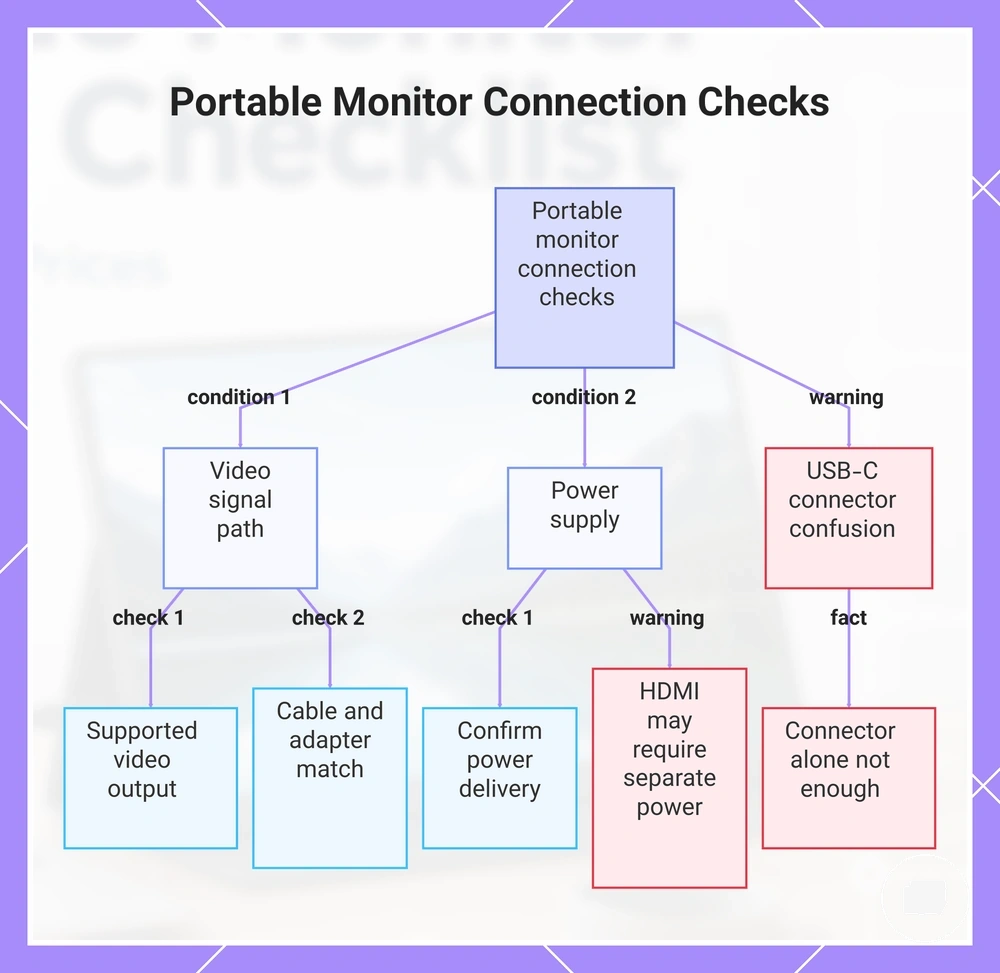
Connection and power must both pass before a portable monitor is likely to work with the target device. A valid video signal and sufficient power are separate checks, so confirming only the port shape is not enough. Checking both conditions before comparing prices can reduce the risk of unexpected accessory needs or connection problems.
Start by confirming that the target device provides the required video output through USB-C, HDMI, or another supported port. Then verify that the cable, any required adapter, and the monitor input support the intended signal path. Power delivery should also be checked separately because a working video connection does not always mean the portable monitor receives sufficient power. If any required condition is missing, an extra accessory may be needed or the connection may fail.
- Confirm the target device provides a supported video output.
- Check that the cable matches both the device port and the monitor input.
- Verify whether an adapter is required for the intended connection.
- Confirm that power delivery or a separate power requirement is satisfied.
- If HDMI is used, check whether separate power may also be required.
USB-C charging, USB-C data, and USB-C video are commonly confused, so the connector alone does not confirm video support. Use the ports and power checklist for a closer look at connection types, and the compatibility checklist to review device-specific conditions before making a purchase decision.
This chart shows the two essential checks (video signal and power) needed for a portable monitor to work, plus a common USB-C confusion warning.
USB-C video support and power delivery
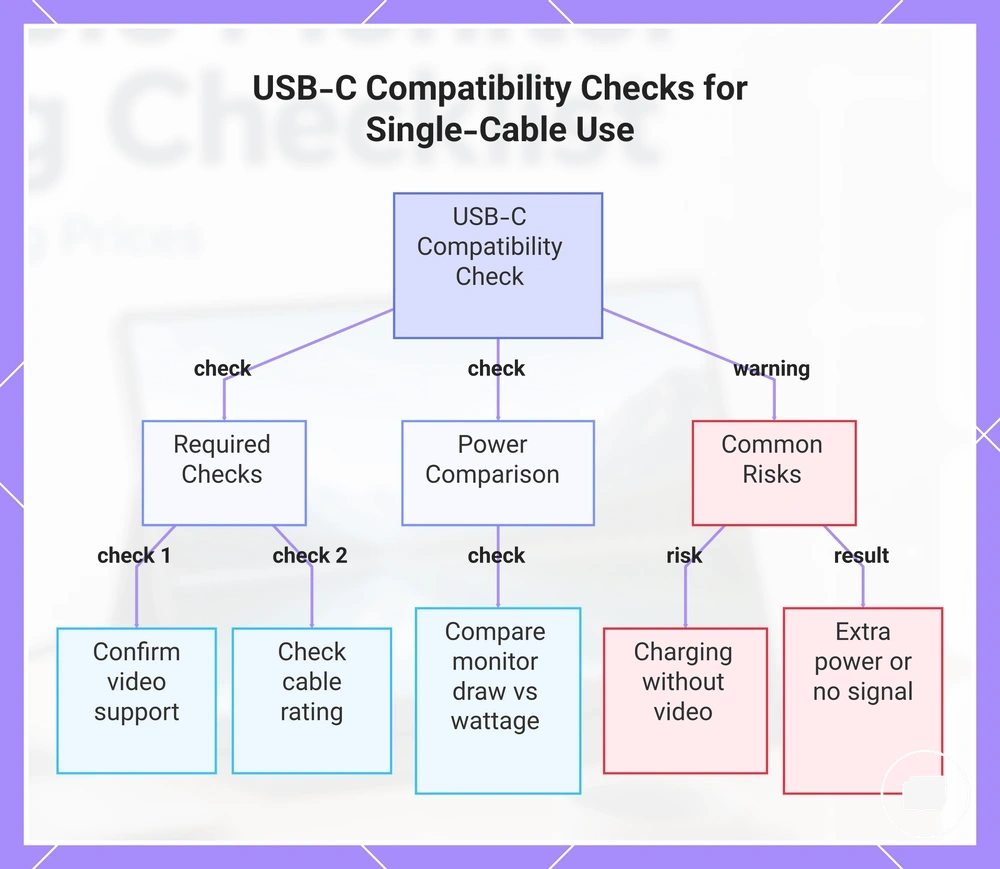
USB-C shape alone is not enough to confirm compatibility. A USB-C port should be checked for both video support and power delivery because the connector does not identify every capability. Whether single-cable use is possible depends on the USB-C port, cable rating, monitor power draw, and supported power behavior.
Verify the following before relying on a USB-C connection:
- Confirm that the USB-C port provides video support.
- Check that the cable rating supports both video transmission and power delivery.
- Compare the monitor power draw with the available charging wattage from the USB-C port.
- If single-cable use is not supported, extra power may be required or the monitor may show no signal.
A common compatibility risk is a USB-C port that supports charging but does not carry video. In that situation, the target device may charge normally while the portable monitor receives no video signal.
This chart shows the key checks and common risks when verifying USB-C support for video and power delivery in a single-cable portable monitor setup.
HDMI, mini HDMI, adapters, and separate power
HDMI carries the video signal, but power should be checked separately. An HDMI or mini HDMI connection may establish video while the portable monitor still requires a separate power source. Whether an adapter or additional power is needed depends on the device, input type, cable, and monitor power requirements.
The table below separates video and power responsibilities so each condition can be checked independently.
| Connection part | What it handles | What still needs checking |
|---|---|---|
| HDMI cable | Video signal | Whether a separate power source is required for the portable monitor |
| Mini HDMI | Video signal through the matching input type | Whether an adapter is needed to match the monitor input |
| Adapter | Connects different input types when required | Compatibility depends on the device and connection requirements |
| Power source | Supplies separate power for the portable monitor | Confirm that available power meets the monitor's power requirements |
A console or an older laptop may provide an HDMI video connection but still require a separate power cable or an adapter if the available input type differs from the portable monitor, creating an accessory gap before the setup can work as intended.
Stand, case, cables, and accessory completeness
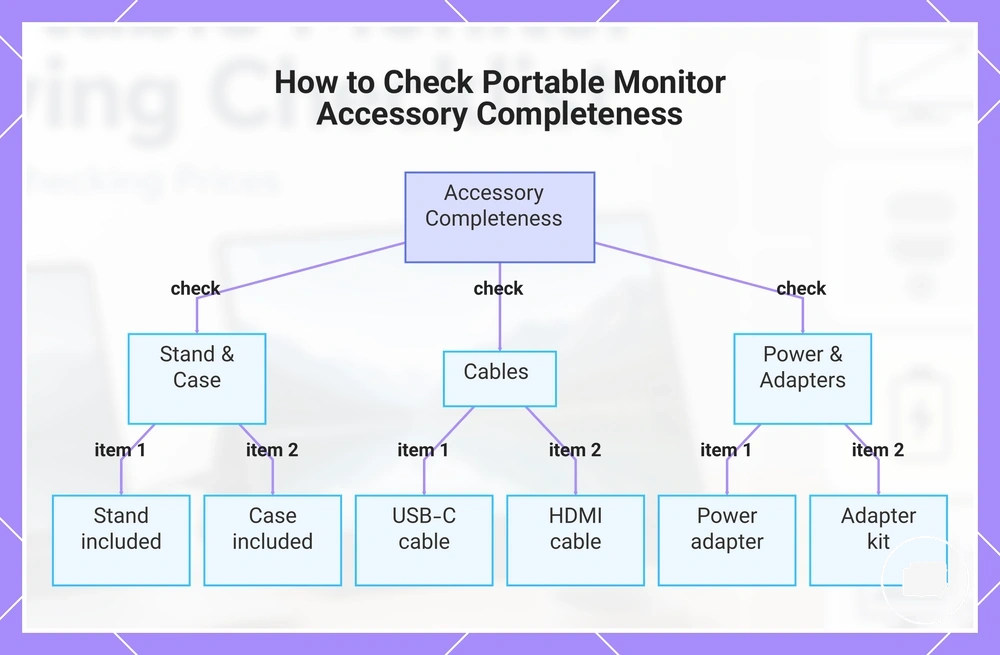
Accessory completeness affects how quickly a portable monitor is ready to use and can influence the total buying cost. A portable monitor package with the required accessories may reduce extra purchases, while missing items may be acceptable when suitable parts are already available. The practical value depends on which accessories are included and whether they match the intended setup.
Check the package contents before making a decision:
- Confirm whether a stand is included to support a comfortable viewing angle and stable placement.
- Check whether a case or protective cover is included if the portable monitor will be carried regularly.
- Verify that a USB-C cable is included when the intended connection uses USB-C.
- Check for an HDMI cable if HDMI is the expected video connection.
- Confirm whether a power adapter is included when separate power may be required.
- Check whether an adapter kit is included if different connection types are expected.
A missing accessory is not always a disadvantage. If the required stand, case, cables, power adapter, or adapter kit are already owned and suitable for the intended setup, the portable monitor package may still provide the required usability and protection without increasing the total buying cost through unnecessary extra purchases.
This chart shows the key accessories to verify in a portable monitor package and notes that missing items may be acceptable if already owned.
Viewing support and protective cover needs
During daily use, viewing support and protective cover features influence how comfortably a portable monitor can be positioned and how well it may be protected during transport. Stand stability affects viewing comfort during desk use, while case coverage can help reduce damage risk when the monitor is carried. The practical benefit depends on the stand design, protective cover, and intended travel routine.
Compare viewing support and protection by checking the following:
- Stand stability: A stable stand can improve viewing support and reduce unwanted movement during desk use.
- Stand angle: Adjustable stand angle and viewing angle options may improve comfort for different working positions.
- Desk stability: Stand grip and fold design can influence how securely the portable monitor rests on the desk.
- Case coverage: A protective cover or protective case may provide better travel protection when it covers the display during transport.
- Travel protection: If the portable monitor is carried between home and work, a fold cover or protective case may improve portability while helping reduce damage risk during travel.
Cable kit and adapter gaps before purchase
A cable kit should be checked before comparing prices because missing cables or adapter gaps can change the real purchase requirement and increase extra cost. A portable monitor may appear ready to use, but the final setup depends on matching connector ends, video support, charging ability, and the target device. Identifying these gaps early can help avoid false savings caused by missing accessories.
Check the cable kit before purchase:
- Connector ends: Confirm that the connector ends match both the portable monitor and the target device.
- Video support: Verify that the selected cable provides the required video support instead of relying on the connector shape alone.
- Charging ability: Check whether the cable and power connection meet the monitor's charging or power requirements when applicable.
- Adapter requirement: If the connector types differ, an adapter gap may create extra cost before the setup is ready to use.
- Spare cable: A spare cable may help maintain a ready-to-use setup when the primary cable is unavailable.
Any adapter need should be verified against the target device because compatibility depends on the available ports and supported connection capabilities.
Buying mistakes that cause avoidable returns
Buying mistakes often lead to avoidable returns because unchecked conditions can create non-working connections, poor usability, or mismatched expectations before a portable monitor is used. Checking compatibility, display, and accessory requirements before purchase can reduce return risk by identifying missing criteria early rather than after the monitor is set up.
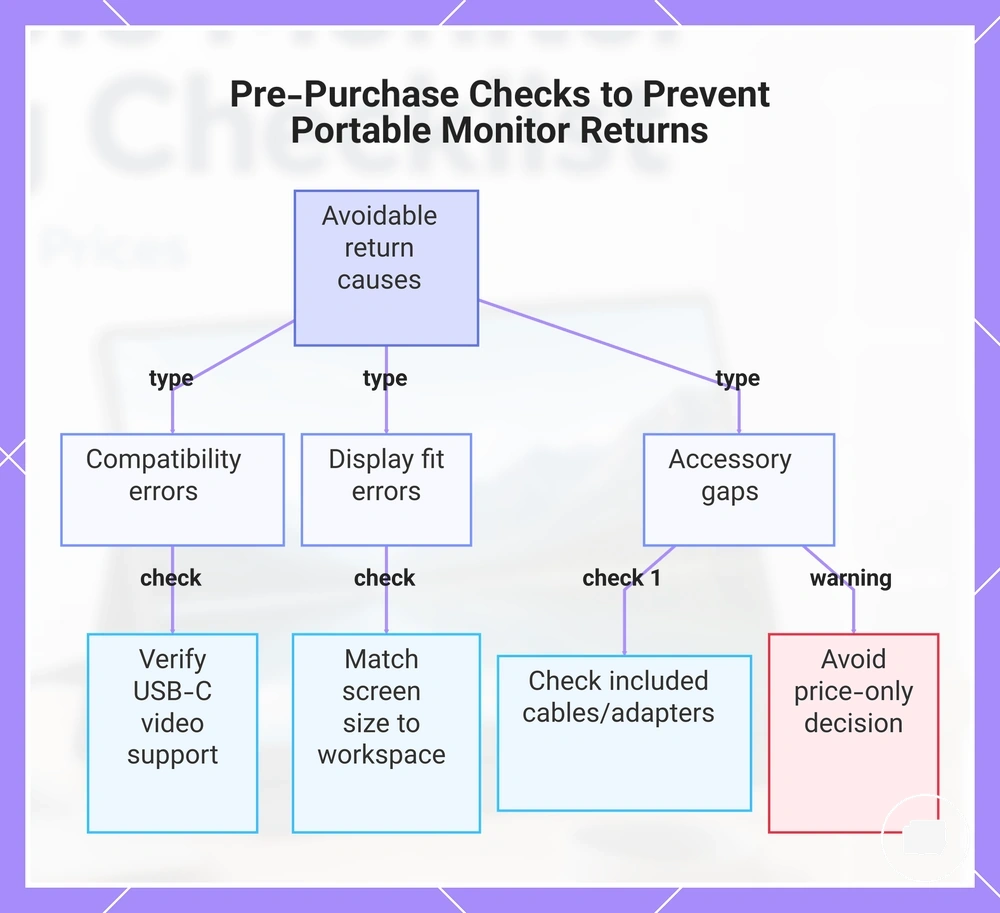
Many purchase errors begin with a compatibility assumption instead of a verified requirement. Assuming every USB-C port supports video, selecting a screen size without considering the intended workspace, overlooking an accessory gap, or making a price-only decision may result in no signal, poor fit, extra cost, or a mismatch between expectations and actual use. A missing criterion is often easier to prevent before purchase than to correct afterward.
- Verify USB-C video support instead of assuming every USB-C connection carries a display signal.
- Match the display to the intended workspace and screen size requirements rather than price alone.
- Check whether required cables, adapters, or other accessories are included or may be needed.
- Confirm compatibility requirements before relying on a lower purchase price that may create extra accessory cost.
- Review buying conditions before purchase to help reduce avoidable returns caused by unchecked conditions.
A buying mistake differs from a post-purchase fault because it usually starts with an unchecked buying condition rather than a problem discovered during normal use. If the purchase criteria have already been confirmed and issues still occur, the common portable monitor problems guide provides the appropriate next step.
This chart shows the three main categories of buying mistakes that cause avoidable returns and the specific checks to prevent them.
Assuming every USB-C port carries video
Not every USB-C port carries video, so a connector that fits correctly may still result in no signal. Whether a portable monitor works depends on the USB-C port, its video capability, the cable capability, any required device setting, and the monitor's power need. A compatibility mistake in any of these supported or unsupported conditions may prevent the display from working.
Check the following before assuming a USB-C connection is ready to use:
- Confirm that the USB-C port supports video capability rather than charging alone.
- Verify that the cable capability matches the required USB-C video connection.
- Review the relevant device setting if video output depends on system configuration.
- Confirm that the monitor's power need is met when additional power may be required.
For example, a charging-only USB-C port may charge a device without carrying video, while a video-capable USB-C port may support an external display when the remaining compatibility conditions are also satisfied.
Choosing by price or screen size alone
Price or screen size alone cannot determine whether a portable monitor is the right option. The truth is that the best choice depends on the combination of compatibility, display quality, accessories, and the intended use case, not a single shortcut. Relying only on price or size can increase mismatch risk even when the monitor appears to meet basic expectations.
Weak shortcut: Compare only the price or screen size.
Better decision criterion: Evaluate screen size alongside readability and portability, confirm compatibility and port fit, review display quality, and check whether accessories such as a stand or case are included before judging the true value. For example, a smaller or lower-budget portable monitor may be the right option when it meets the required features, matches the intended use case, and avoids unnecessary total cost.
Price check after the checklist passes
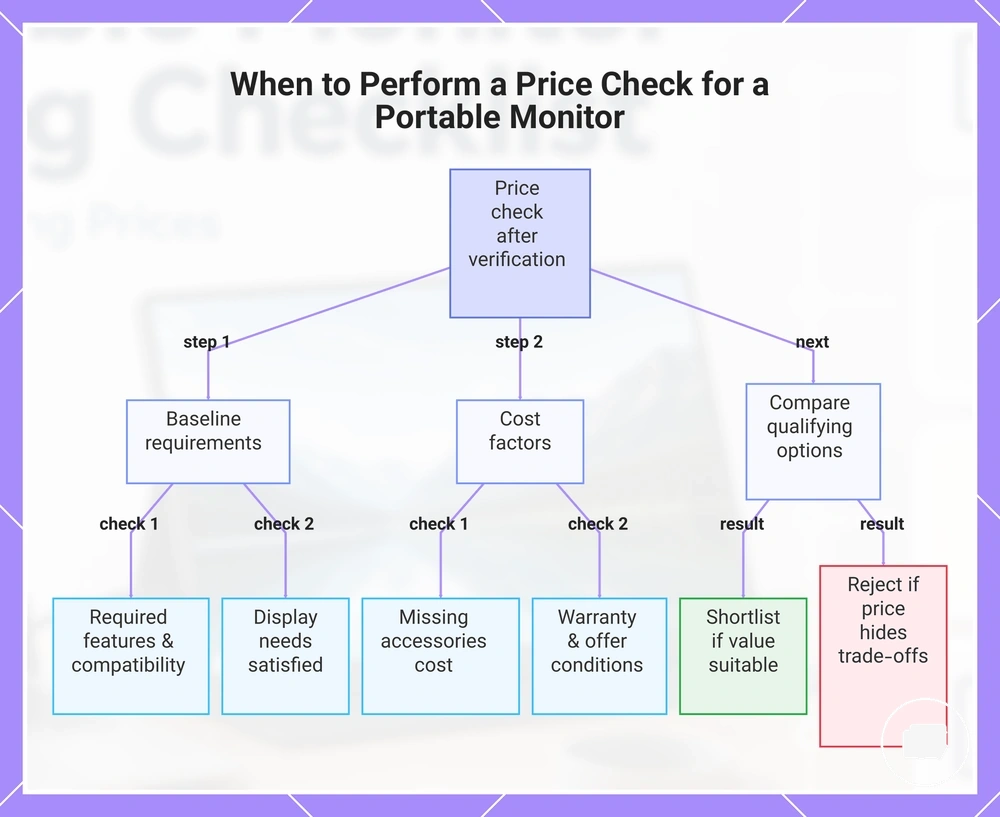
A price check should come only after the checklist passes for fit, compatibility, display needs, and accessories. Comparing prices before verifying these requirements can make a lower-priced portable monitor appear better value even when missing accessories or missing required features change the value condition.
Required features should be confirmed before the price comparison starts because a lower indicative price range may not reflect the total cost. Missing accessories, such as a stand, case, cables, or power adapter, may create a false saving when they are needed for the intended setup. Use the price-readiness checklist below to keep the value check tied to verified requirements.
- Confirm the required features for the intended use.
- Verify compatibility with the target device and required ports.
- Check that display needs are already satisfied.
- Identify missing accessories that may affect total cost.
- Review warranty context and offer conditions before comparing options.
Warranty context and offer conditions can affect the value condition because the same portable monitor may carry different buying risks depending on what is included, excluded, or unclear. The portable monitor price and value guide provides broader buying guidance for judging indicative price range and value without relying on price alone.
After the required features, missing accessories, warranty context, indicative price range, and offer conditions are clear, compare only the options that still meet the checklist. Shortlist a portable monitor when the value condition remains suitable, or reject it when the price depends on ignored trade-offs, unclear offer conditions, or extra purchases that change the total cost.
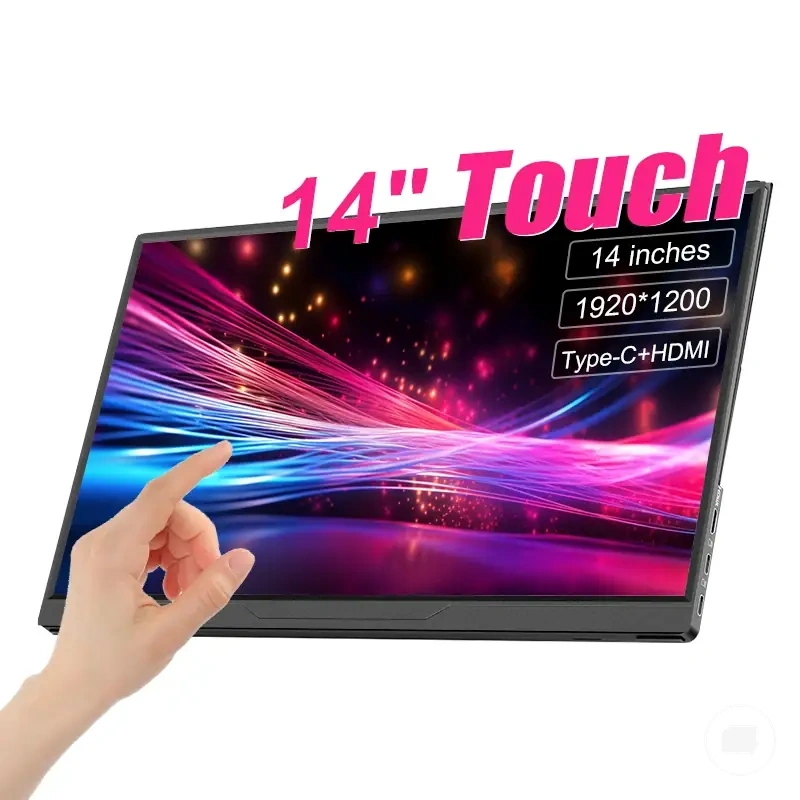
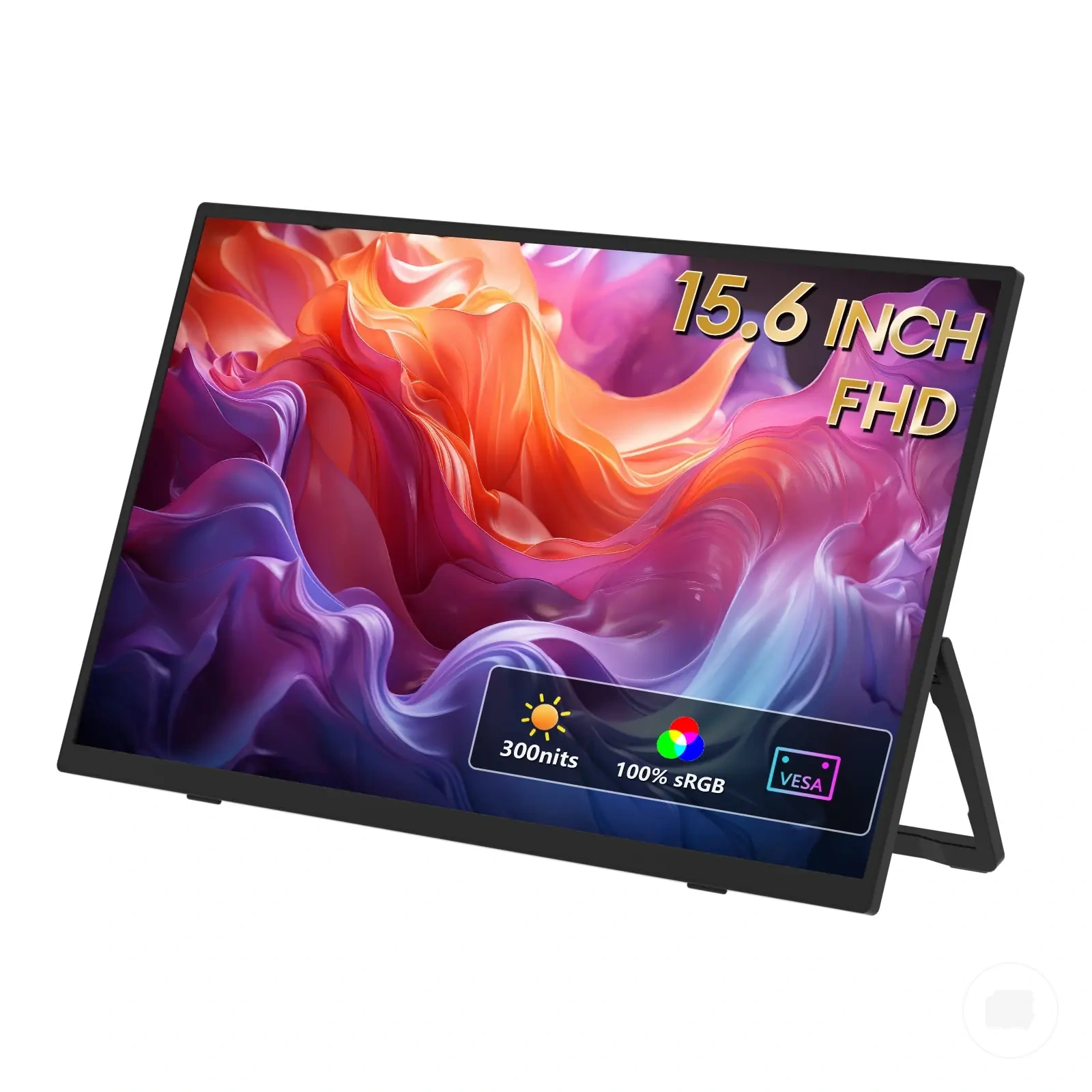
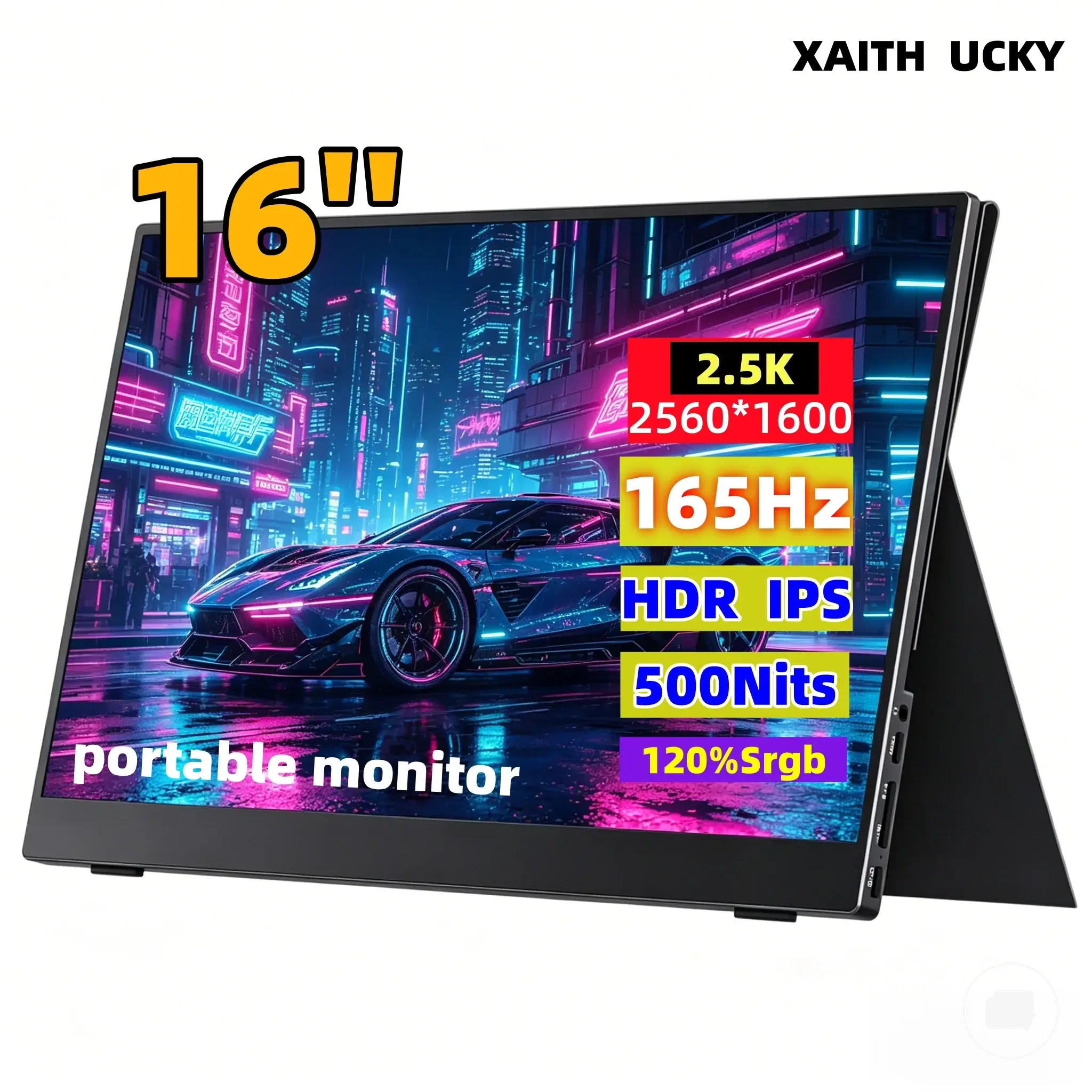
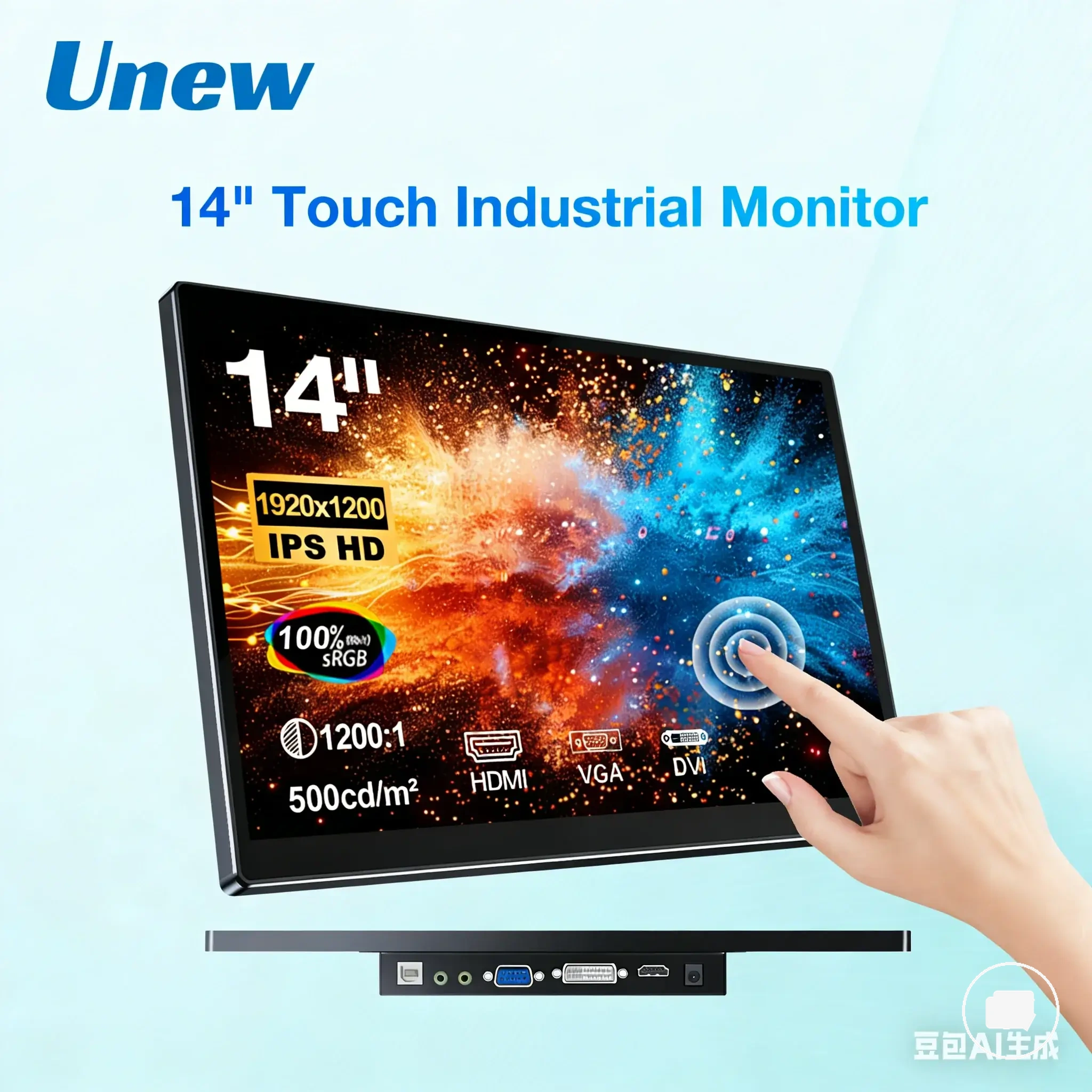
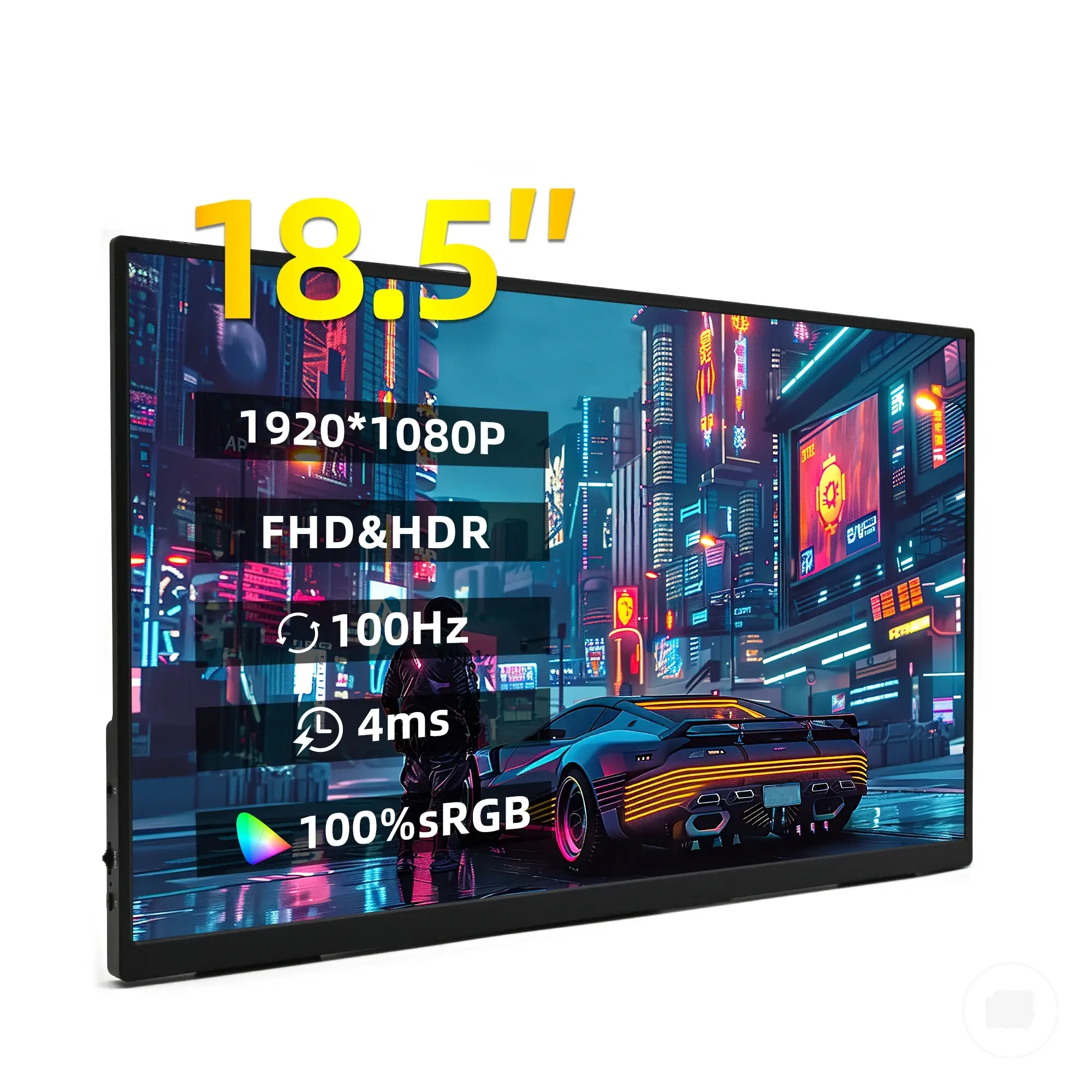
The products below are useful examples for comparing available options. Before buying, check that the compatibility criteria, key features, and product details match your needs.
This chart shows the prerequisite checks required before comparing prices and the final decision based on value condition.
Budget range versus required features
A budget range should be judged against required features rather than product names or price bands alone. Display quality, connection type, included accessories, touch support, and portability requirement determine whether a budget represents suitable value or may lead to a false economy when important feature requirements are overlooked.
| Required feature | Budget effect | Acceptable compromise | Risk if missing |
|---|---|---|---|
| Display quality | May influence the suitable budget range | Lower specifications may be acceptable for basic viewing needs | May reduce readability or overall value |
| Connection type | May affect cable or adapter requirements | A simpler connection may be acceptable when it matches the target device | May increase setup cost or compatibility risk |
| Included accessories | May change the total cost | Missing accessories may be acceptable if suitable replacements are already available | May create a false economy through extra purchases |
| Touch support | May increase the required budget range | Standard display use may be acceptable when touch input is unnecessary | May increase cost without matching the intended workflow |
| Portability requirement | May affect size, weight, and accessory needs | A less portable design may be acceptable for fixed desk use | May reduce convenience during travel |
If the budget range exceeds the available budget, remove nonessential features before raising spending. An acceptable compromise usually removes a preference rather than a required feature, while eliminating a required feature may result in a false economy.
Offer checks without product-page decision drift
Offer checks must be evaluated against the portable monitor criteria, with those criteria remaining the decision anchor. An offer may appear attractive, but included accessories, return terms, warranty signal, shipping context, affiliate CTA clarity, and final cost should still support the original selection criteria. If the offer weakens the fit, compatibility, display, or accessory requirements, it should be compared cautiously or avoided.
Review these offer signals before following a partner redirection:
- Included accessories: Confirm whether the offer includes the cables, stand, case, or power adapter needed for the intended setup.
- Return terms: Review the condition wording so the return terms are clear before relying on the offer.
- Warranty signal: Treat unclear or unsupported seller claims as a potential risk signal rather than proof of value.
- Shipping context: Check whether the shipping context changes the final cost or practical value of the offer.
- Condition wording: Compare new, used, refurbished, or open-box wording with the expected product condition.
- Affiliate CTA: The affiliate CTA should make redirection behavior clear without replacing category-level selection logic.
Product examples may illustrate the decision, but they should not replace category-level selection logic or the portable monitor criteria as the decision anchor.