
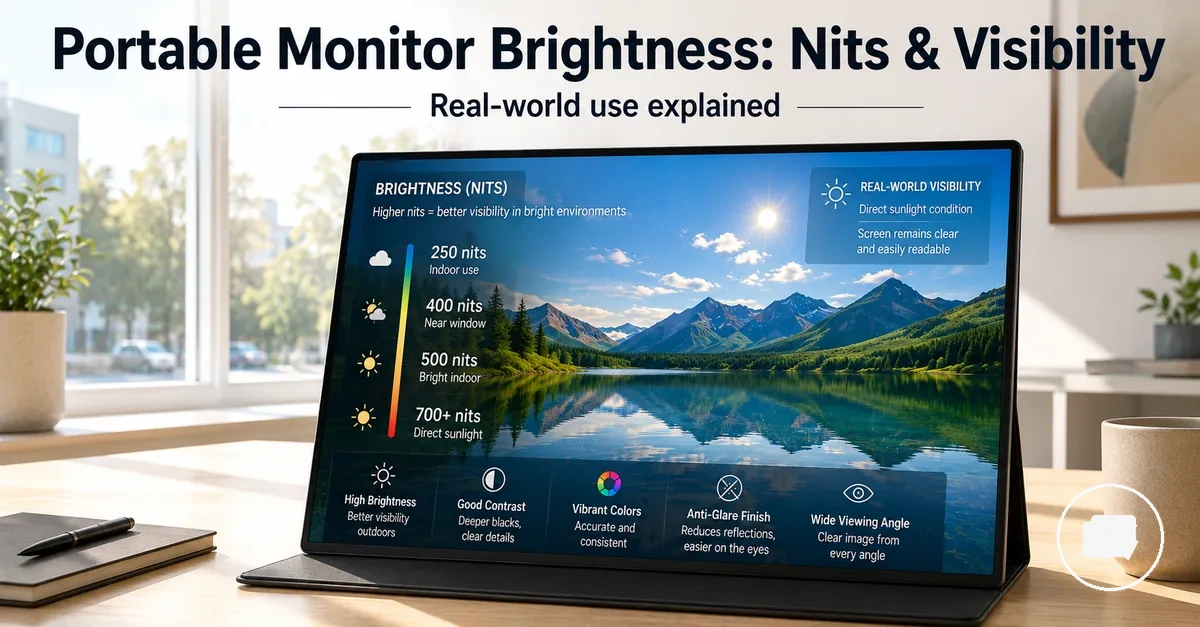
Portable monitor brightness and visibility guide
Portable monitor brightness is the amount of light the screen produces, and it is commonly expressed in nits. As a decision-support attribute, portable monitor brightness influences visibility, reading comfort, and everyday usability, although the result can vary with ambient light, screen finish, viewing angle, power mode, and the intended use case.
Portable monitor brightness affects how easily text, images, and interface elements can be seen in different environments. A screen that feels comfortable in controlled indoor lighting may appear less readable in brighter surroundings because glare, reflections, contrast, and ambient light also influence perceived visibility.
Choosing portable monitor brightness is therefore about matching the display to the environment rather than focusing on the brightness rating alone. For broader context on selecting a portable display, see this portable monitor guide.
Higher brightness can improve visibility in certain situations, but it does not automatically guarantee a better viewing experience. Practical readability usually depends on how brightness works together with screen finish, contrast, lighting conditions, and the way the portable monitor is used.
What portable monitor brightness means
Portable monitor brightness is the amount of light the screen emits, and it is usually expressed in nits. The brightness rating describes the screen's light output, while the visibility you experience can still vary with the viewing condition, ambient light, and other environmental factors.
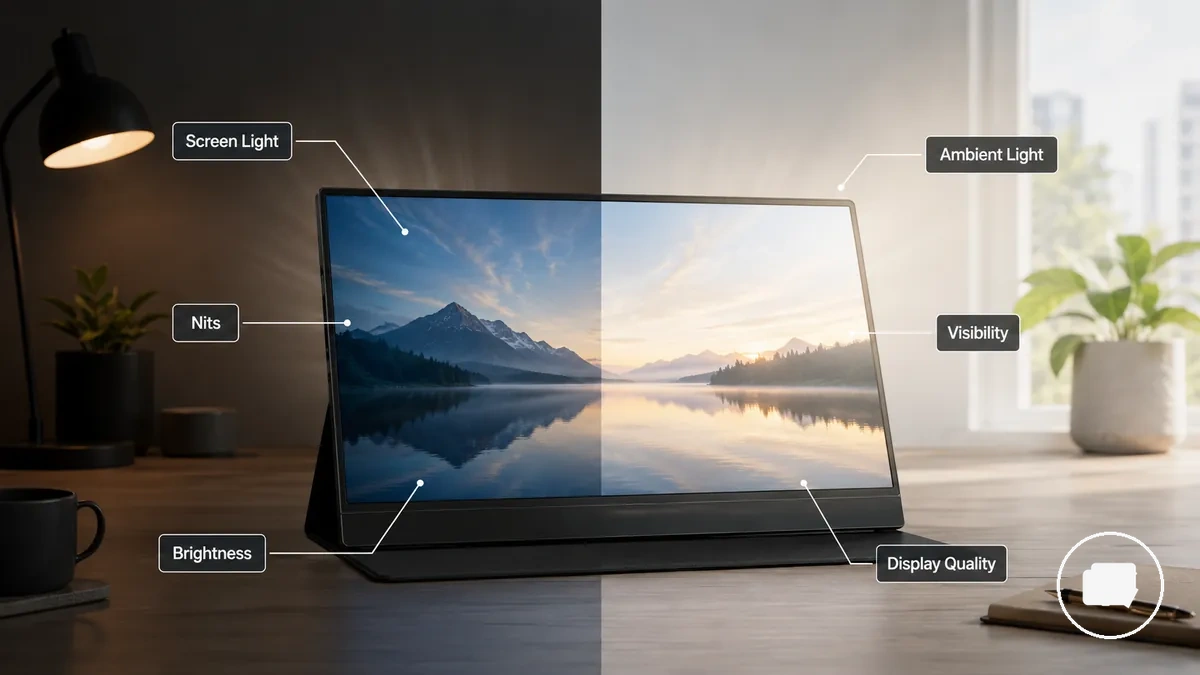
A portable monitor's brightness rating helps indicate how much light the screen can produce. Higher brightness may improve visibility in brighter surroundings, but the viewing experience also depends on the viewing condition rather than the brightness rating alone.
Portable monitor brightness is one aspect of display quality, not a complete measure of the overall viewing experience. For broader context on related display characteristics, see the portable monitor display quality guide.
How nits describe screen brightness
Nits are the measurement used to compare a portable monitor's screen brightness. The brightness rating indicates how much light the screen can emit, while the practical effect on visibility still depends on the viewing condition rather than the nit value alone.
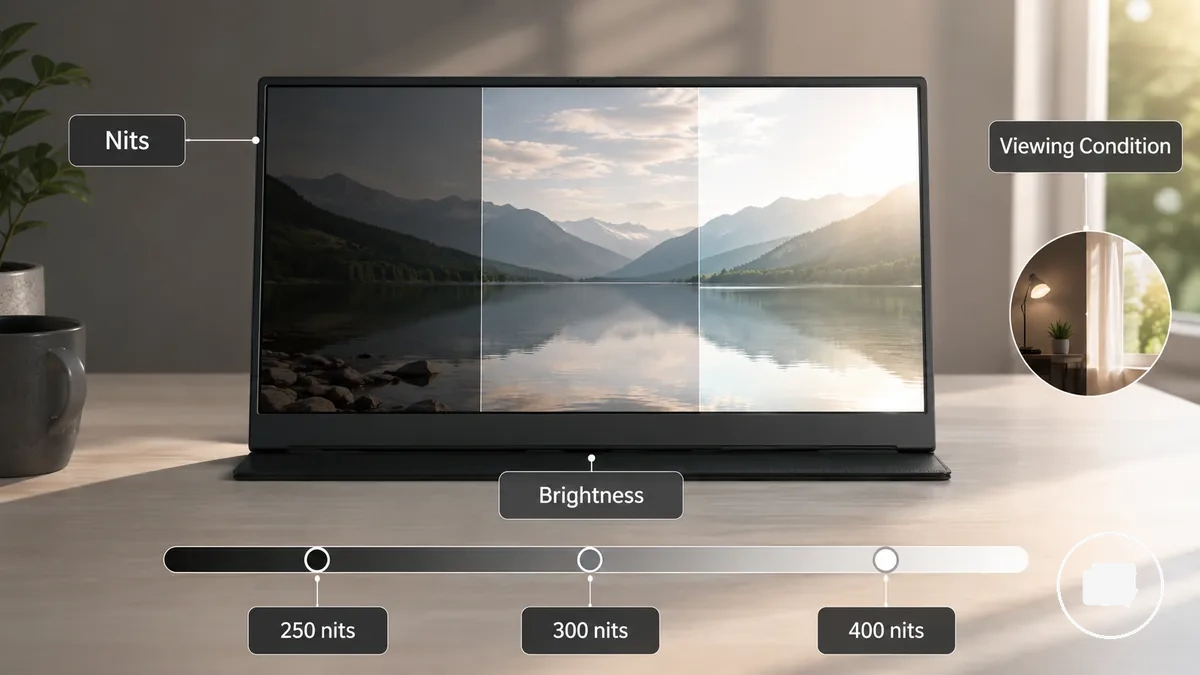
The ranges below provide a practical way to interpret brightness ratings across different lighting conditions. They organize expectations by likely viewing environment and readability, but they are contextual examples rather than fixed rules.
| Brightness range | Likely environment | Practical meaning | Watch-outs |
|---|---|---|---|
| 250 nits | Controlled indoor lighting | May be suitable for many everyday indoor tasks | Can become harder to read in brighter surroundings |
| 300 nits | Typical indoor conditions | May provide greater flexibility across common lighting | Visibility still depends on ambient light and glare |
| 400 nits | Brighter indoor areas | May improve readability in stronger light | Does not guarantee outdoor visibility or display quality |
| Higher nits | More demanding lighting | Can offer additional screen light output | Interpret alongside the viewing condition, not as a universal indicator |
Why brightness ratings do not guarantee visibility
A brightness rating indicates a portable monitor's light output, but it does not guarantee how visible the screen will be in every situation. Visibility depends on the viewing condition, including ambient light, glare, contrast, screen finish, reflected light, and viewing angle, which can change whether the screen appears clear or washed out.
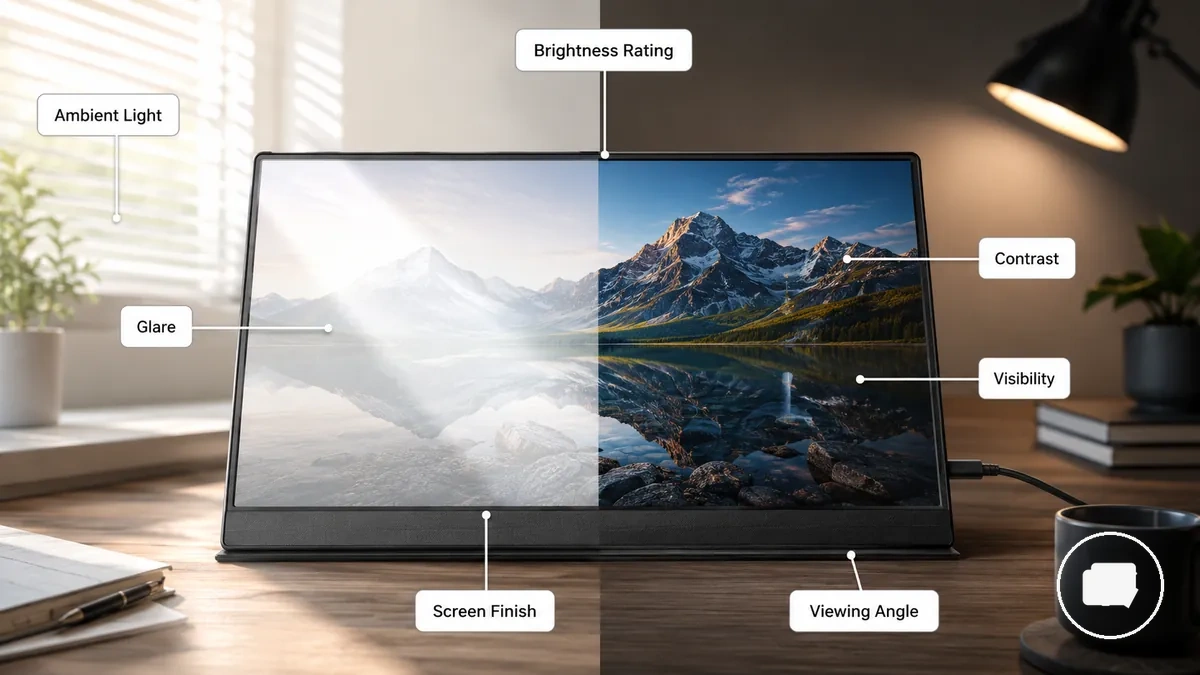
The comparison below shows why the brightness rating should be considered alongside the environment in which the portable monitor is used. Each factor influences perceived visibility, so the screen experience depends on their combined effect rather than the brightness rating alone.
| Brightness rating says | Real-world visibility depends on |
|---|---|
| Available screen light output | Ambient light and reflected light |
| Light-producing capability | Contrast and screen finish |
| Display brightness potential | Viewing angle and screen position |
| One display characteristic | Whether the screen remains readable or appears washed out under the viewing condition |
Portable monitor brightness ranges by environment
Portable monitor brightness ranges depend on the environment in which the display will be used rather than on the brightness value alone. Ambient light, glare, screen coating, and viewing angle can all influence visibility, so the most appropriate brightness range varies with the work location and lighting conditions.
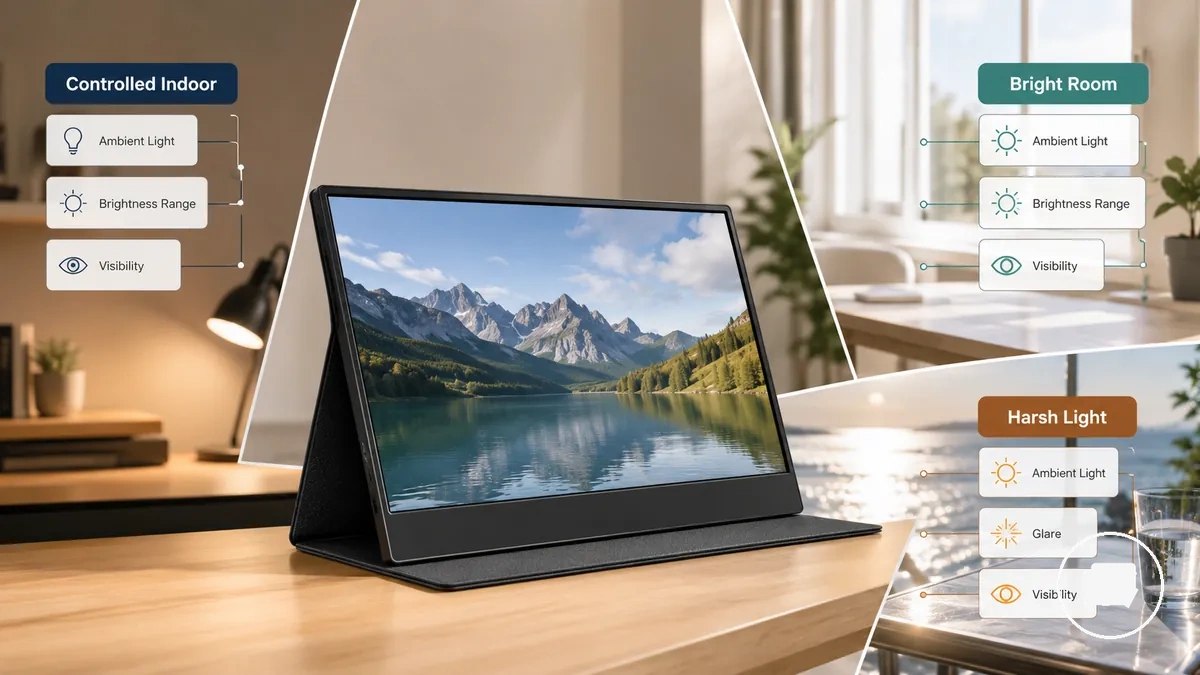
The table below connects common environments with general brightness ranges and practical visibility considerations. These ranges provide selection guidance rather than fixed outcomes because viewing conditions can change the result.
| Environment | Typical brightness need | Visibility risk | Selection note |
|---|---|---|---|
| Controlled indoor lighting | Lower to moderate brightness range | Usually lower glare | May suit consistent indoor lighting |
| Bright room | Moderate to higher brightness range | Reflections may reduce visibility | Consider ambient light, screen coating, and viewing angle together |
| Harsh light conditions | Higher brightness range | Strong reflected light can still affect readability | Higher brightness may help, but the environment remains an important factor |
Matching brightness ranges to your typical environment can improve selection confidence because visibility depends on multiple conditions. For practical usage scenarios, see portable monitor visibility for work.
Indoor desk work and controlled lighting
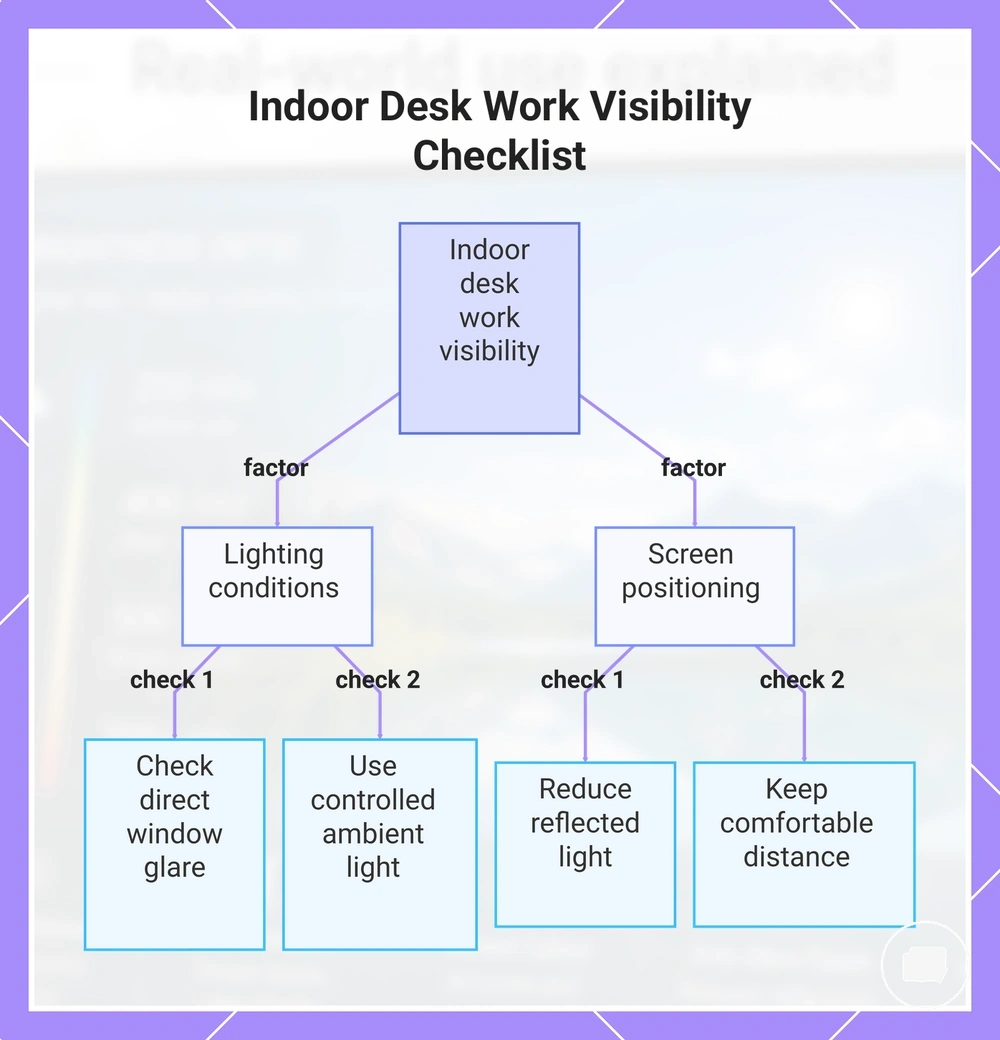
Indoor desk work may only require moderate brightness when lighting is controlled and glare is limited. The most suitable brightness depends on ambient light, window position, screen distance, and how much reflected light reaches the portable monitor rather than on a single brightness level.
The checklist below helps assess whether an indoor workspace is likely to support comfortable visibility with moderate brightness by focusing on the conditions that influence screen readability.
- Check whether direct window light creates glare on the display.
- Position the portable monitor to reduce reflected light where practical.
- Keep the screen distance comfortable for your normal viewing position.
- Use controlled ambient light to help maintain more consistent visibility.
This chart shows the key conditions to check for comfortable screen readability with moderate brightness in an indoor workspace.
Bright rooms, cafes, and travel workspaces
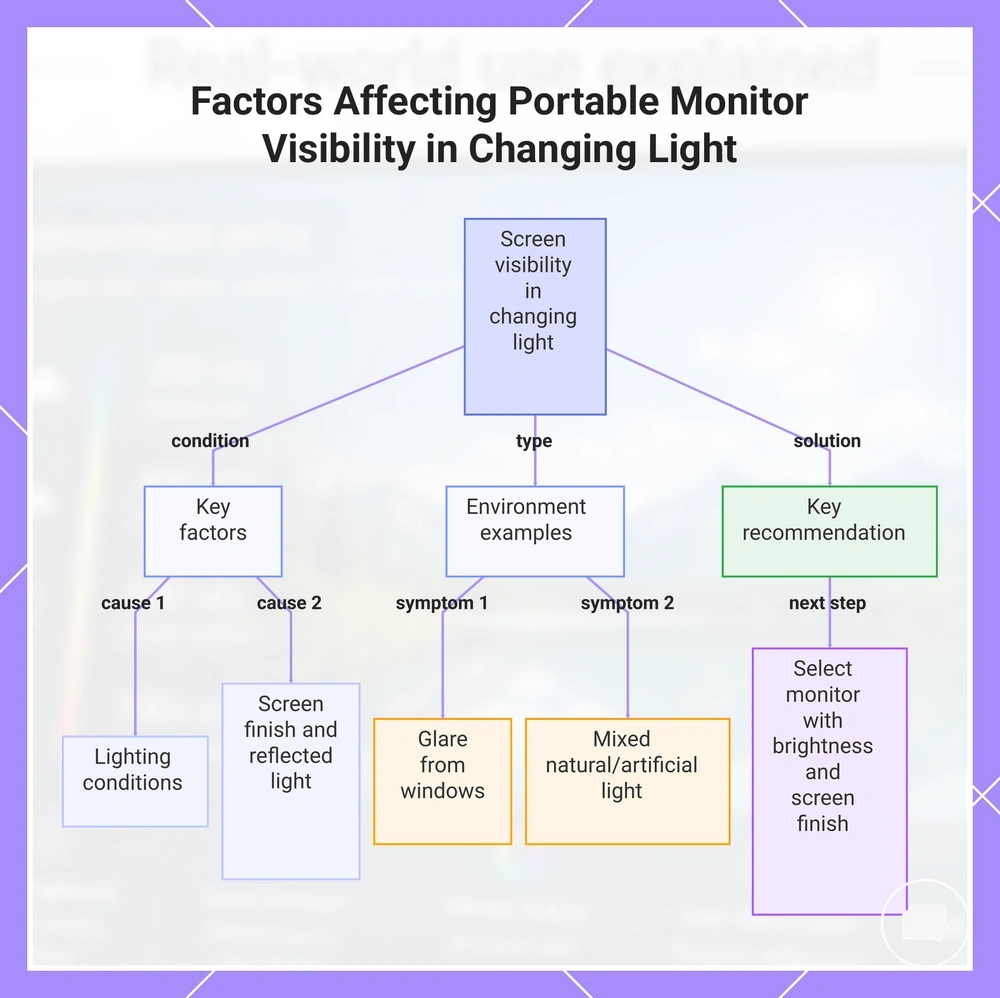
Bright rooms, cafes, and travel workspaces may require more brightness and better glare control because ambient light can change throughout the day. Visibility depends on lighting conditions, screen finish, and reflected light rather than on brightness alone.
Changing-light environments can affect screen readability in different ways. The examples below highlight how lighting conditions may influence visibility.
- Cafes: Large windows or shifting sunlight may increase glare and reduce screen visibility.
- Airports: Bright overhead lighting and changing seating positions can alter viewing conditions.
- Coworking spaces: Mixed natural and artificial light may create changing visibility throughout the day.
- Hotel rooms: Uneven lighting may make screen finish and brightness more important for comfortable viewing.
When lighting varies, selecting a portable monitor with brightness and screen finish suited to those conditions can help reduce visibility risk, although the result still depends on the surrounding environment.
This chart illustrates the key factors and common lighting challenges that affect screen visibility in bright rooms, cafes, and travel workspaces, along with a practical recommendation for monitor selection.
Sunlight and very high brightness expectations
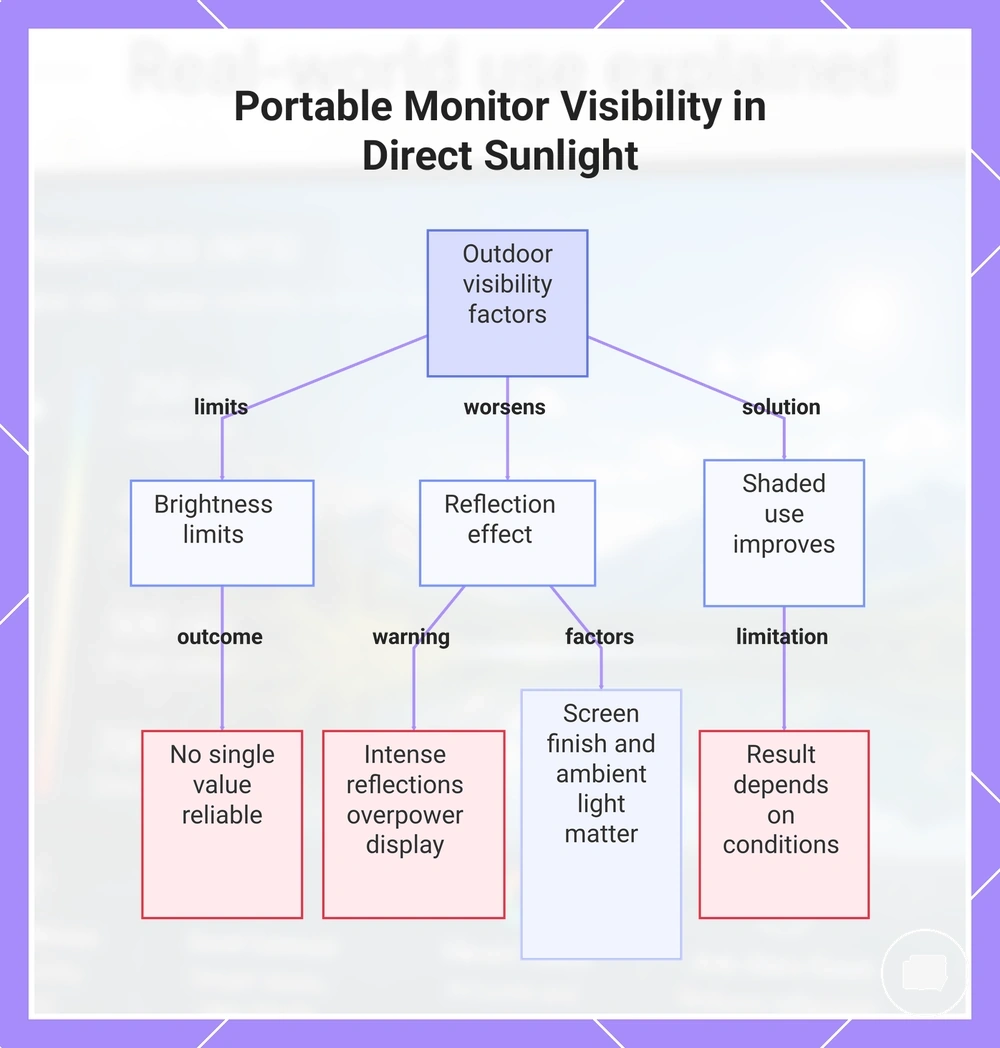
Portable monitor visibility in direct sunlight depends on reflection, luminance demand, and viewing conditions rather than on very high brightness alone. Bright indoor environments and direct sunlight are different situations, so a brightness threshold that feels suitable indoors may still result in a washed-out image outdoors.
When sunlight falls directly on the display, reducing reflections through shaded use can be as important as increasing brightness. Screen finish, ambient light, and viewing angle all influence visibility, so no single brightness value can reliably predict outdoor readability.
Caution: Ordinary portable monitors may not remain comfortable to use in direct sun because intense reflections and high ambient light can overpower the display. Using the monitor in shade may improve visibility, but the result still depends on the surrounding conditions.
This chart explains why portable monitor visibility in bright outdoor conditions depends on factors beyond peak brightness, including reflections and shade.
300 nits, 400 nits, and higher brightness levels
Brightness levels should be compared by viewing conditions rather than treated as quality rankings. Whether 300 nits, 400 nits, or a higher brightness level is more suitable depends on the environment, glare tolerance, and how the portable monitor will typically be used.
The comparison below shows how common brightness levels may suit different conditions. Higher brightness can improve visibility in stronger ambient light, but screen finish, reflections, and glare control also influence the viewing experience.
| Brightness level | Best-fit environment | Main benefit | Main limitation | Selection signal |
|---|---|---|---|---|
| 300 nits | Typical indoor environments with stable lighting | May provide comfortable viewing for many everyday indoor tasks | Can become less comfortable when glare or ambient light increases | May be suitable when lighting conditions are usually predictable |
| 400 nits | Brighter indoor spaces and changing lighting conditions | May improve visibility where reflections are more noticeable | Does not guarantee comfortable viewing in direct sunlight | Consider when brighter workspaces are common and glare tolerance is important |
| Higher brightness levels | More demanding lighting environments | Can provide additional light output in stronger ambient light | Visibility still depends on reflections, screen finish, and surrounding conditions | May deserve greater priority when lighting variability is a more important consideration than other display attributes |
Brightness is one display attribute among several selection criteria. When lighting remains consistent, other display characteristics may be equally important, while brighter and more variable environments may justify placing greater emphasis on brightness.
When 300 nits is enough
300 nits may be enough for a portable monitor when it is used in controlled indoor light with low glare and typical productivity tasks. Acceptable visibility depends on the surrounding lighting, screen finish, and viewing conditions, so 300 nits should be viewed as a conditional choice rather than a universal level for every environment.
- Controlled indoor lighting with limited changes in ambient light.
- Low-glare surroundings or a matte screen that helps reduce reflections.
- Normal productivity tasks such as document editing, spreadsheets, web browsing, and office work.
- Viewing conditions where direct sunlight or strong reflections are not expected.
When 400 to 500 nits is worth considering
400 to 500 nits may be worth considering when a portable monitor is used in bright indoor environments or moved frequently between locations with changing lighting conditions. This brightness range can provide a greater visibility margin in those situations, although the benefit should be balanced against possible power and cost trade-offs rather than viewed as a requirement for every user.
If your typical workspace includes brighter indoor environments or frequent mobility, the checklist below can help determine whether this brightness range aligns with your usage.
- You regularly work in bright indoor environments with stronger ambient light.
- You frequently move between offices, cafés, coworking spaces, or similar work locations.
- You want additional visibility margin when lighting conditions are less predictable.
- You are comfortable with potential power and cost trade-offs that may accompany a brighter display.
When 1000 nits is a specialist requirement
1000 nits is typically a specialist requirement rather than the default choice for a portable monitor. This level of very high brightness may be appropriate when outdoor-like glare or other specialist visibility needs are expected, but it is not generally necessary for normal office work, travel, or everyday laptop productivity.
Very high brightness may involve higher cost and can come with greater heat and power expectations depending on the display and operating conditions. Even with 1000 nits, good screen positioning and effective glare control remain important because very high brightness alone does not replace proper viewing conditions.
Screen finish, glare, and reflected light
Screen finish influences how bright a portable monitor appears by changing how much glare and reflected light reach your eyes, not by changing the display's actual brightness. The same brightness level may provide different visibility depending on how effectively reflections are controlled.
Reflected light can reduce contrast perception, making screen content appear less distinct even when the brightness setting remains unchanged. Managing reflections may help maintain visibility, while the outcome still depends on ambient lighting and viewing conditions.
The comparison below highlights how matte and glossy finishes may affect perceived brightness and visibility under different lighting conditions.
| Matte finish | Glossy finish |
|---|---|
| May reduce glare and reflected light. | May reflect more surrounding light in brighter environments. |
| Can help preserve contrast perception when ambient light increases. | May provide stronger perceived contrast when reflections are limited. |
| May improve visibility where glare control is important. | May suit controlled lighting with minimal reflected light. |
Matte screens for glare control
Matte screens can improve glare control by diffusing reflections, which may lower glare intensity and make a portable monitor easier to view in bright rooms or other reflective environments. This effect changes how brightness is perceived through reduced reflected light, but it does not increase the display's measured nit rating.
Matte screens may improve visibility when reflected light is distracting, although the result still depends on ambient lighting and viewing conditions. They can help reduce the impact of reflections, but they do not eliminate glare in every situation or change the display's actual brightness output.
Screen angle and placement for better visibility
Screen angle and placement can improve portable monitor visibility by reducing reflected glare without changing the display's brightness rating. Adjusting the relationship between the screen, the light source, and your viewing distance may make on-screen content easier to read when reflections are present.
Small positioning changes can alter reflection intensity, which may improve readability under the same lighting conditions. A quick visibility check can help determine whether repositioning is likely to improve the viewing experience:
- Angle the screen to reduce direct reflections from the primary light source.
- Position the monitor so bright light is less likely to reflect toward your eyes.
- Maintain a comfortable viewing distance that supports clear readability.
- Assess visibility after repositioning instead of relying on the brightness rating alone.
Brightness trade-offs in portable monitor selection
Brightness trade-offs should be evaluated against the environment where a portable monitor will be used rather than by brightness alone. A higher brightness level may improve readability in stronger ambient light, but it can also involve greater power draw, more heat, and higher cost depending on the display and operating conditions.
Selection is usually easier when brightness is considered alongside contrast, readability, and the expected use environment. Higher brightness may be more valuable where lighting changes frequently, while moderate brightness may be sufficient in consistently controlled indoor conditions.
The table below summarises the practical trade-offs that can influence brightness selection beyond visibility alone.
| Trade-off | What changes | Why it matters | When to prioritize it |
|---|---|---|---|
| Power draw | Higher brightness may increase power consumption. | Can influence battery-powered or mobile use. | Prioritize when working away from reliable power sources. |
| Heat | Higher brightness may generate more heat during extended use. | May affect comfort depending on the display and usage conditions. | Consider during longer working sessions. |
| Cost | Higher-brightness displays may cost more. | Helps balance budget against expected lighting conditions. | Prioritize higher brightness when brighter environments are common. |
| Contrast and readability | Higher brightness may improve readability in stronger ambient light. | Perceived visibility still depends on glare, reflections, and the use environment. | Give greater priority when lighting conditions frequently change. |
Power draw and heat at higher brightness
Power draw and heat may increase as the brightness setting increases, although the effect depends on the display, operating conditions, and duration of use. Higher brightness can improve readability in stronger ambient light, but it may also increase energy use and thermal load, which can reduce portability or affect comfort during longer sessions.
If you expect to use higher brightness regularly, the checks below can help confirm that your setup is suitable for the additional power demand and heat without assuming the same outcome for every portable monitor.
- Verify that the power source can support the monitor during higher-brightness use.
- Check that the USB-C connection and cable are suitable for the monitor's power requirements, when applicable.
- Consider whether battery-powered use may be affected by increased energy demand.
- Monitor heat comfort during extended sessions if higher brightness is used for long periods.
Contrast, colour, and readability at different brightness levels
Contrast, colour perception, and readability depend on brightness levels as well as the viewing environment. A brightness setting that suits one task may improve text readability or colour visibility differently in another, so the most suitable level depends on the task and surrounding conditions.
Brightness can affect perceived clarity differently depending on how the portable monitor is used. The comparison below shows how task suitability may change when balancing contrast perception, colour visibility, readability, and eye comfort.
| Task | Brightness consideration | Why it matters |
|---|---|---|
| Text work | Choose a brightness level that supports clear text readability. | Readability and perceived contrast may depend on ambient light and viewing conditions. |
| Media viewing | Adjust brightness to suit the surrounding lighting. | Colour visibility and perceived contrast may vary with the environment. |
| Creative tasks | Use a brightness level appropriate for the workspace and display. | Perceived colour and contrast can change with brightness and viewing conditions. |
Brightness alone does not determine colour appearance or eye comfort, because both depend on viewing conditions and individual preferences. For more detail on display considerations for creative work, see portable monitor colour and brightness needs.
Choosing brightness for your portable monitor use case
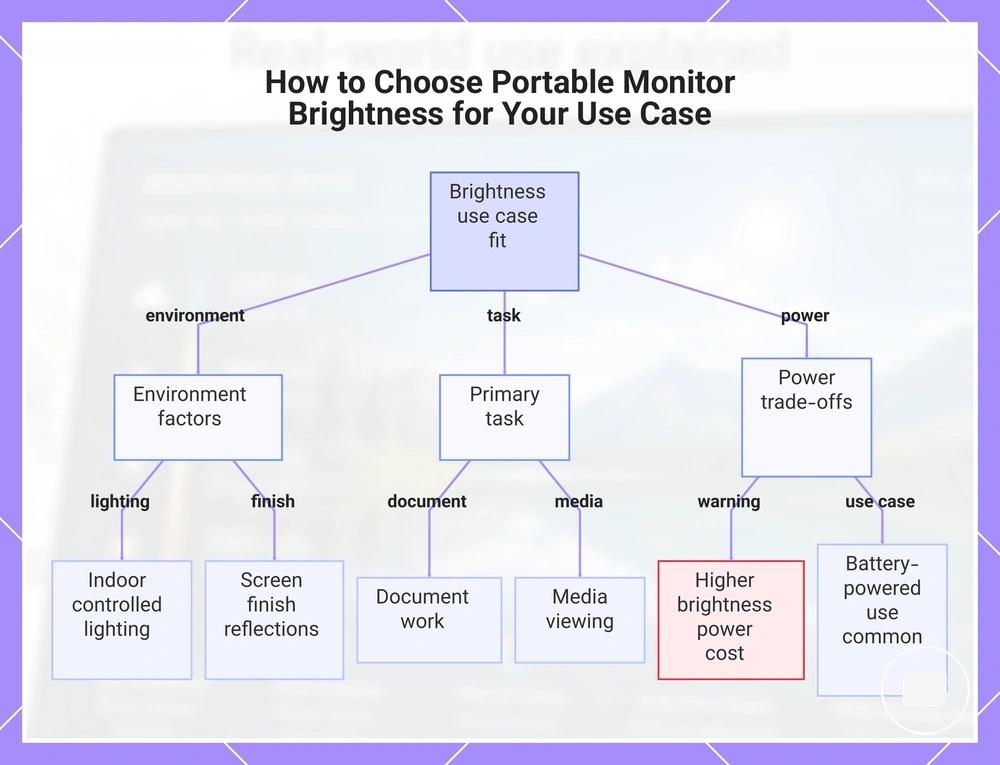
Choosing brightness for a portable monitor use case depends on the environment, the task, the screen finish, and your power expectations rather than on the highest brightness rating alone. The most suitable brightness requirement is the one that matches how the monitor will typically be used.
Use the checklist below to compare your typical use case with the conditions that are most likely to influence a practical buying decision. These criteria help translate brightness specifications into everyday selection factors.
- Consider whether your environment is mainly indoors with controlled lighting, brightly lit, or frequently changing.
- Match the brightness requirement to your primary task, such as document work, media viewing, or mixed productivity.
- Consider whether the screen finish may help reduce reflections in your usual workspace.
- Decide whether higher brightness is worth the possible increase in power demand during regular use.
- Consider whether battery-powered use is common, as higher brightness may increase energy use.
- Choose a brightness level that balances readability and viewing comfort under your typical conditions.
A buying decision is usually more effective when brightness is evaluated together with task suitability, viewing conditions, screen finish, and practical trade-offs instead of as an isolated specification.
Applying these criteria can help narrow your choice to a portable monitor that better matches your everyday use case without giving unnecessary priority to brightness beyond what your environment and workflow may require.
The products below are useful examples for comparing available options. Before buying, check that the compatibility criteria, key features, and product details match your needs.
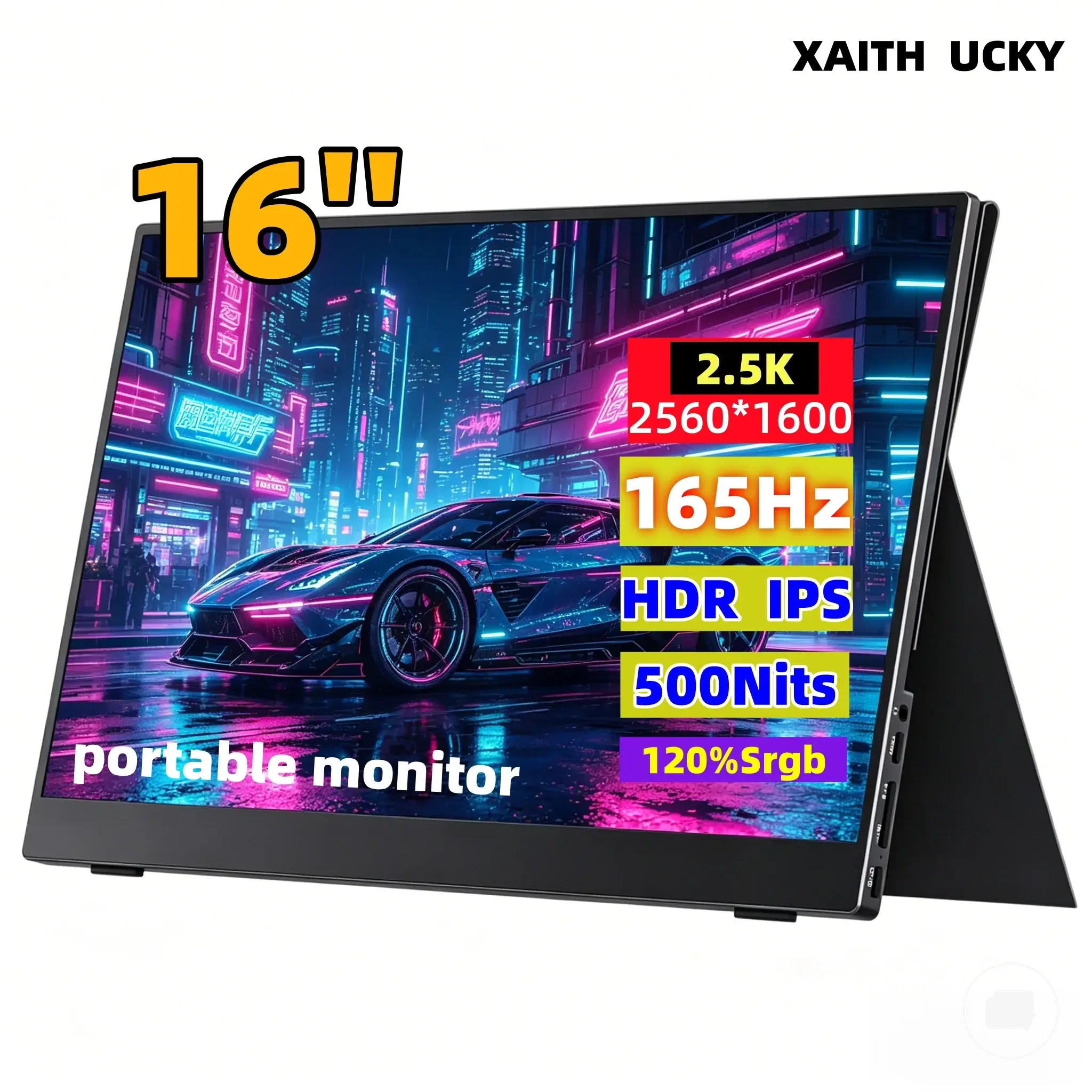
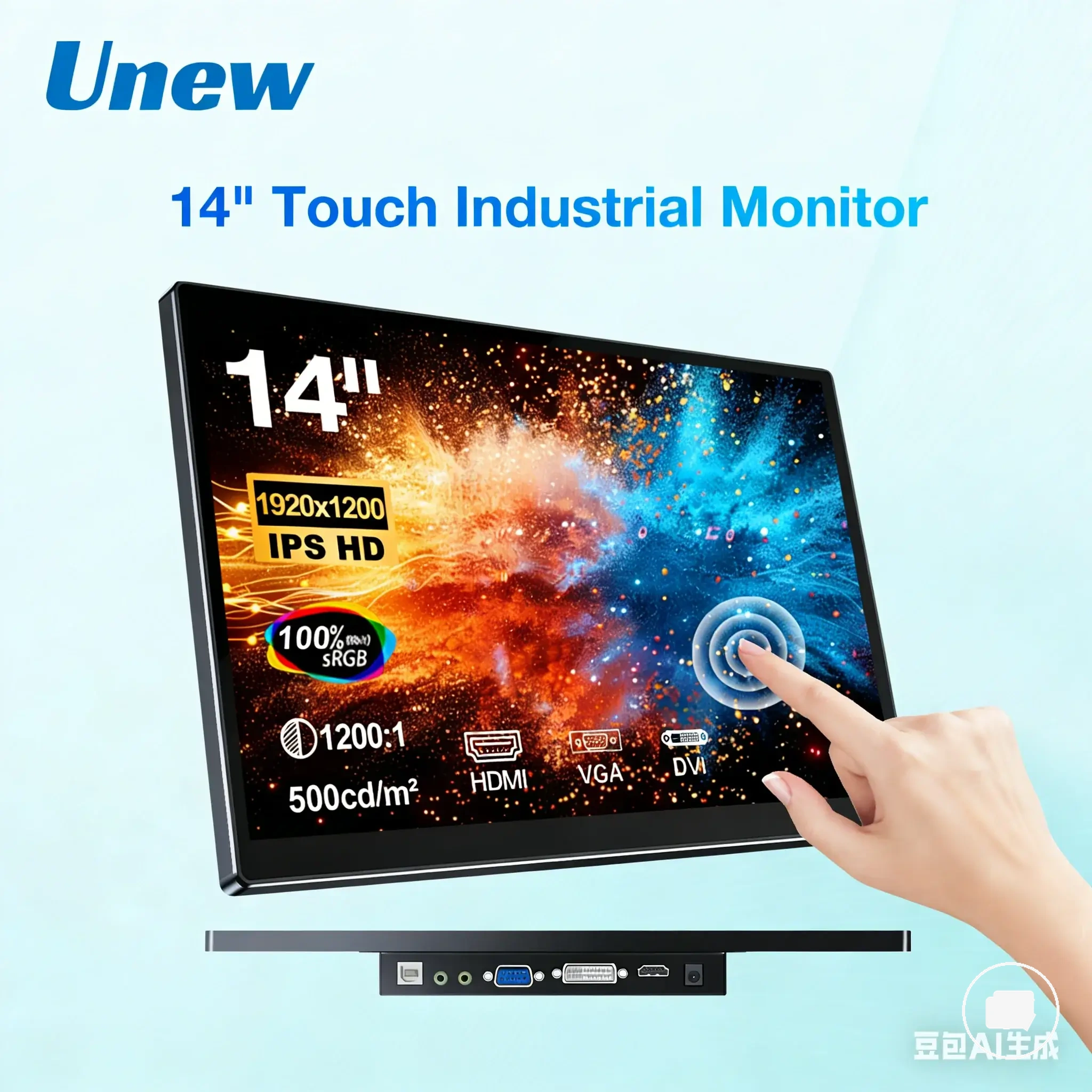
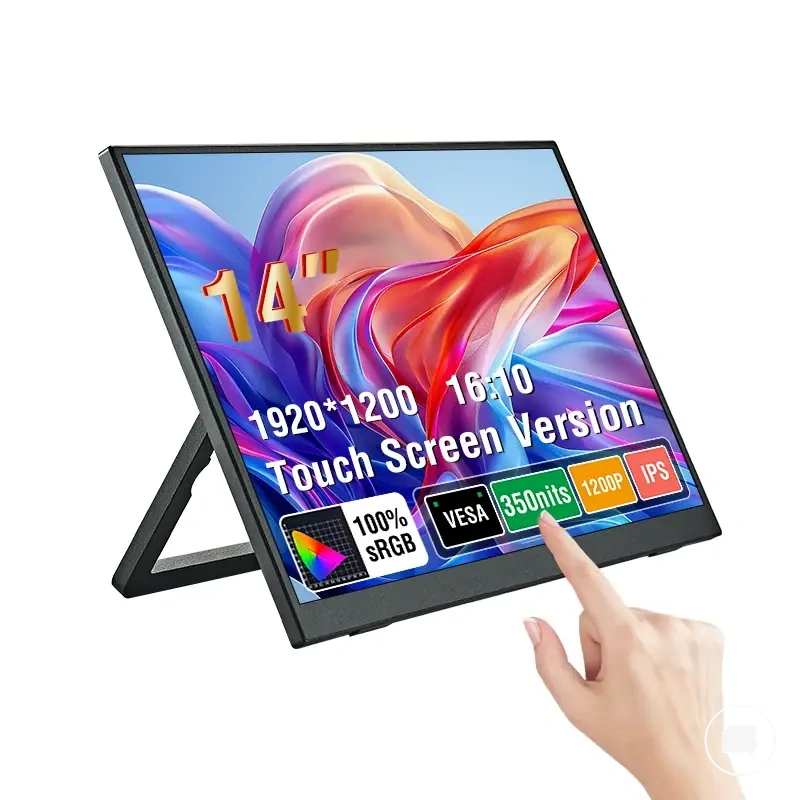
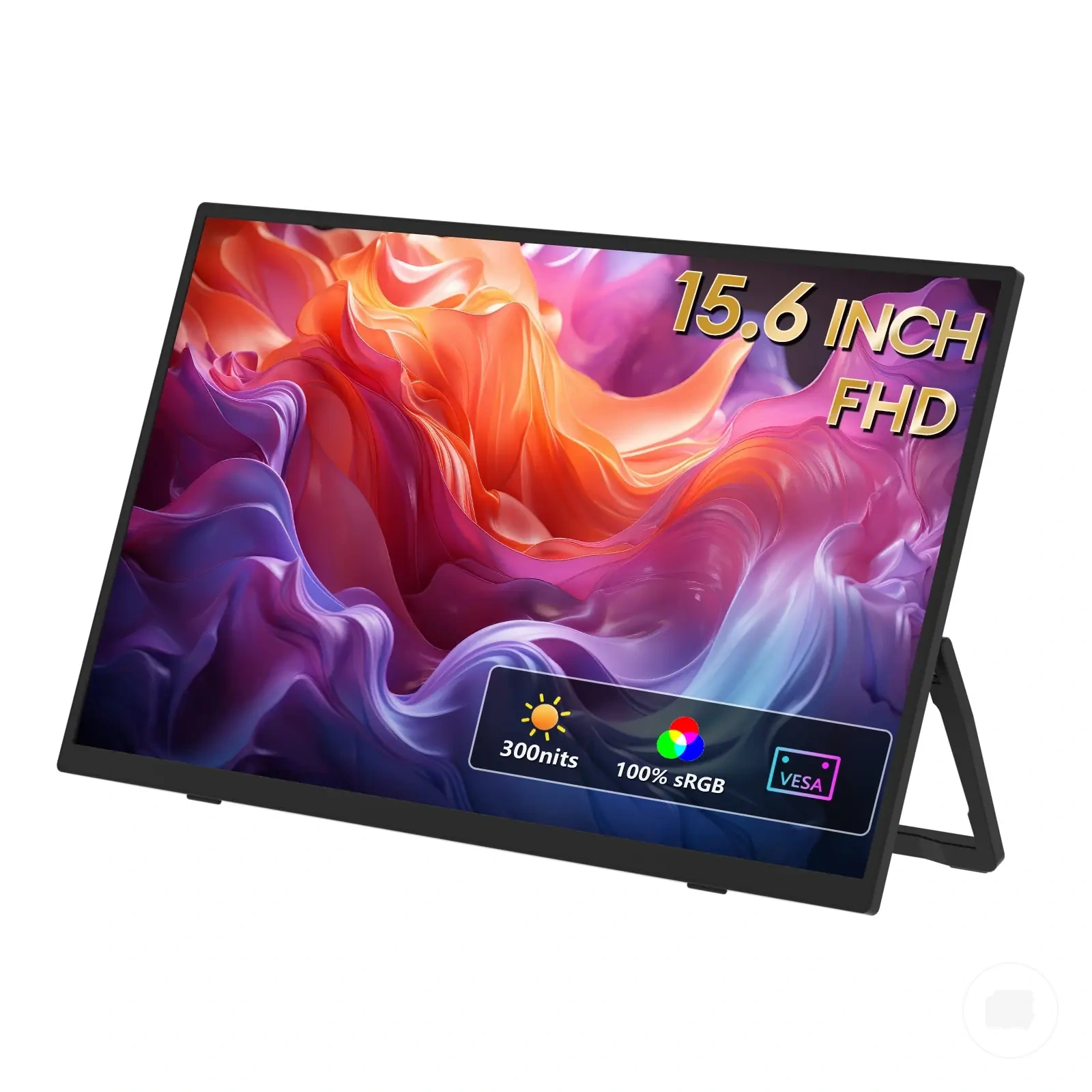
This chart shows the key factors for selecting portable monitor brightness: environment, task, and power trade-offs, helping you match brightness to your typical use case.
Brightness needs for laptop work and productivity
Laptop work and productivity tasks usually benefit from a brightness comfort range that supports text readability under the available ambient light rather than the highest possible brightness setting. The most suitable brightness level depends on the task and viewing conditions, so choosing a level that keeps text clear may provide a more comfortable working experience.
Different productivity activities can place slightly different demands on visibility while keeping readability as the primary goal.
- Writing: Prioritize clear text readability, as a comfortable brightness level may reduce visual strain in changing ambient light.
- Spreadsheets: Dense tables and smaller text may benefit from brightness that maintains readable contrast.
- Coding: Long reading sessions often benefit from consistent text visibility, so brightness may need adjustment as ambient light changes.
- Video calls: Brightness should keep participants and interface elements easy to distinguish while remaining comfortable for extended use.
Brightness needs for laptop work may change throughout the day as ambient light changes, making occasional adjustment more practical than relying on one fixed setting. For broader guidance on work-related viewing scenarios, see portable monitor visibility for work.
Brightness needs for gaming and media
Gaming and media can change brightness expectations because shadow visibility, glare tolerance, viewing comfort, and perceived contrast depend on both the content and the surrounding ambient light. The most suitable brightness level depends on the viewing environment rather than on maximum brightness alone.
Different entertainment scenarios may place different emphasis on brightness while keeping the focus on visibility instead of gaming-specific features.
| Use case | Brightness focus | Selection implication |
|---|---|---|
| Gaming | May benefit from brightness that supports shadow visibility and comfortable contrast under the available ambient light. | Select a brightness level that matches the viewing environment instead of relying on maximum output. |
| Streaming media | Brightness can influence perceived contrast and viewing comfort during longer viewing sessions. | Choose a brightness level that helps maintain comfortable viewing with minimal glare. |
| Console use | Brightness expectations still depend primarily on the viewing environment. | Base the selection on visibility and comfort rather than treating brightness as an indicator of gaming performance. |
Brightness alone does not determine gaming quality or media performance. Refresh rate, input lag, and device compatibility are separate considerations, so brightness should be selected primarily to support visibility, contrast perception, and viewing comfort.
Brightness adjustment and dim screen problems
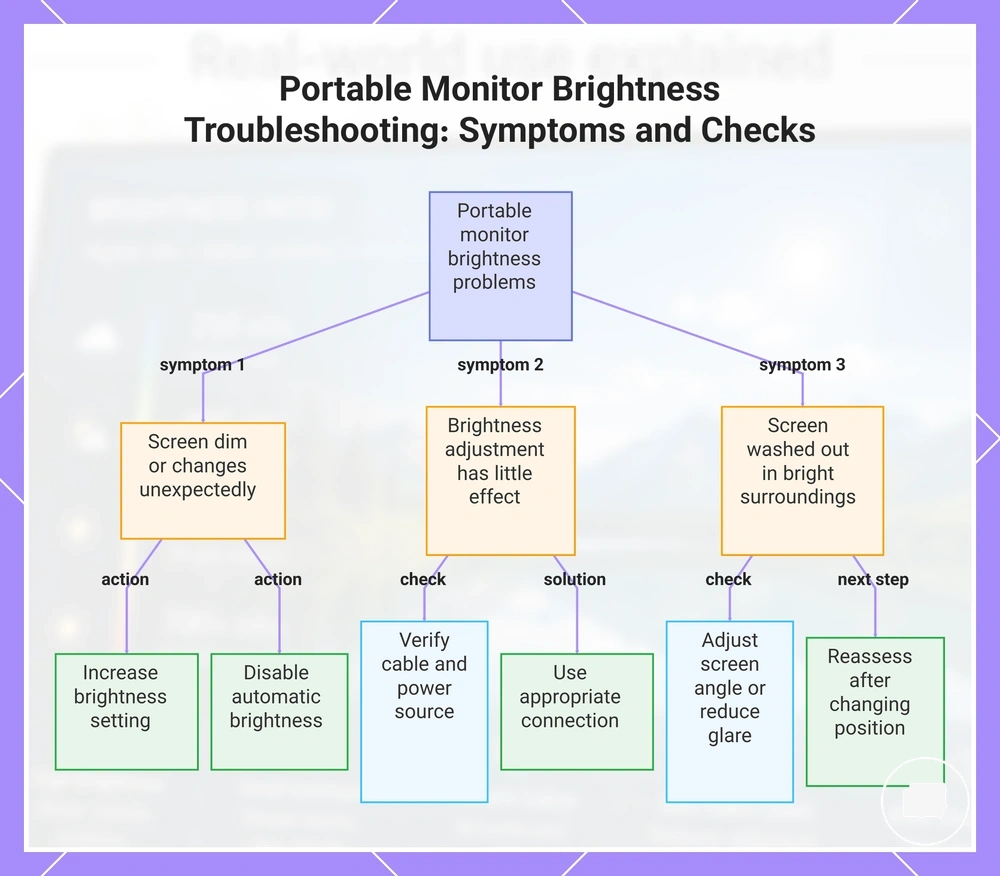
When a portable monitor has a dim screen or the brightness adjustment does not respond as expected, the likely cause may be the monitor settings, source-device controls, cable power limits, or ambient glare rather than a single hardware fault. Identifying the symptom first can help narrow the next safe check without assuming every brightness problem has the same cause.
Brightness-related issues can have different causes even when the display appears similarly dim. Checking each possible factor in a logical order may help determine whether the issue is related to settings, power, or the viewing environment before considering broader troubleshooting.
Use the diagnostic checklist below to compare the symptom with the most likely cause, the appropriate check, and a safe next action.
- Symptom: Screen appears dim at all times.
Likely cause: Monitor settings or source-device controls may be limiting brightness.
Check: Compare the monitor brightness setting with the display controls on the connected device.
Safe next action: If either setting is reduced, increasing it may improve screen visibility. - Symptom: Brightness adjustment has little or no effect.
Likely cause: Cable power limits or the current power source may restrict display performance.
Check: Verify that the cable and power source are suitable for the monitor, when applicable.
Safe next action: If power delivery is limited, using an appropriate connection may improve brightness. - Symptom: Screen looks washed out or difficult to see only in bright surroundings.
Likely cause: Ambient glare may reduce perceived brightness.
Check: Adjust the screen angle or reduce reflected light.
Safe next action: Reassess visibility after changing the viewing position or lighting. - Symptom: Brightness changes unexpectedly.
Likely cause: Source-device controls or automatic brightness features may be active.
Check: Review the connected device's display settings where available.
Safe next action: Confirm whether automatic brightness behaviour is influencing the display.
If these checks do not explain the dim screen or brightness adjustment behaviour, the issue may involve broader signal, power, or device detection conditions rather than brightness alone. For those situations, see portable monitor brightness issues.
This chart shows three symptom groups for dim screen or unresponsive brightness adjustment, with the safe checks and actions for each.
Monitor menu controls versus system brightness sliders
When brightness adjustments do not behave as expected, the monitor menu controls and the system brightness sliders may be affecting different displays or different parts of the display path. The response depends on the connected device, the monitor, and how brightness controls are implemented, so changing one control may not always change the portable monitor's brightness.
Comparing the control source with the display that responds can help distinguish whether the brightness behaviour is related to the monitor controls or the connected device instead of indicating a brightness fault.
| Control source | Usually affects | Check | What it means |
|---|---|---|---|
| Monitor menu controls | The portable monitor's own brightness controls. | Adjust the monitor's on-screen brightness setting and observe whether the display changes. | If the monitor responds, brightness adjustment is likely being handled by the monitor itself. |
| System brightness sliders | The connected device's display or supported external display controls. | Adjust the system brightness slider and compare which display responds. | If only one display changes, the system brightness slider may not control the portable monitor in the same way. |
Different portable monitors and connected devices can handle brightness controls differently, so behaviour may vary between models and operating environments. Comparing both control sources is usually the safest first step before assuming a brightness adjustment problem.
Common reasons a portable monitor still looks dim
When a portable monitor still looks dim after the brightness settings have been checked, the likely cause may be related to power, glare, display mode, or the screen finish rather than the brightness controls themselves. Comparing the visible symptom with the most likely cause can help identify the next safe check without assuming every dim-looking portable monitor has the same explanation.
Use the checklist below to narrow the possible cause before moving to broader troubleshooting. The result may vary by monitor model, power source, display mode, and viewing conditions.
- Cause: Limited power delivery.
Visible symptom: The screen remains dim even when brightness settings are increased.
Check: Confirm that the monitor is receiving suitable power through the current connection, when applicable.
Likely next step: If power delivery appears limited, try an appropriate power source or connection. - Cause: Ambient glare.
Visible symptom: The display appears dim mainly in bright surroundings.
Check: Reduce reflected light or adjust the screen angle.
Likely next step: Reassess visibility after changing the viewing environment. - Cause: Display mode or image settings.
Visible symptom: Brightness appears lower than expected under certain viewing conditions.
Check: Review the monitor's display mode or picture settings, if available.
Likely next step: Compare available display modes to determine whether brightness perception changes. - Cause: Screen finish.
Visible symptom: Reflections make the display appear less bright than expected.
Check: Consider whether the screen finish and surrounding lighting are affecting visibility.
Likely next step: Improve glare control or reposition the monitor before assuming a brightness fault. - Cause: Combined viewing conditions.
Visible symptom: The display looks acceptable in one location but dim in another.
Check: Compare brightness under different ambient lighting conditions.
Likely next step: Adjust the viewing environment as well as the brightness settings if needed.